
Waves
Lesson overview
This lesson introduces the core physics idea, the useful equipment and the calculation or data skills used on this page.
What you will learn
Ray and ripple examples supplied on this page
Use the mirror, glass block, gap and lens examples to practise wave behaviour and diagram language.
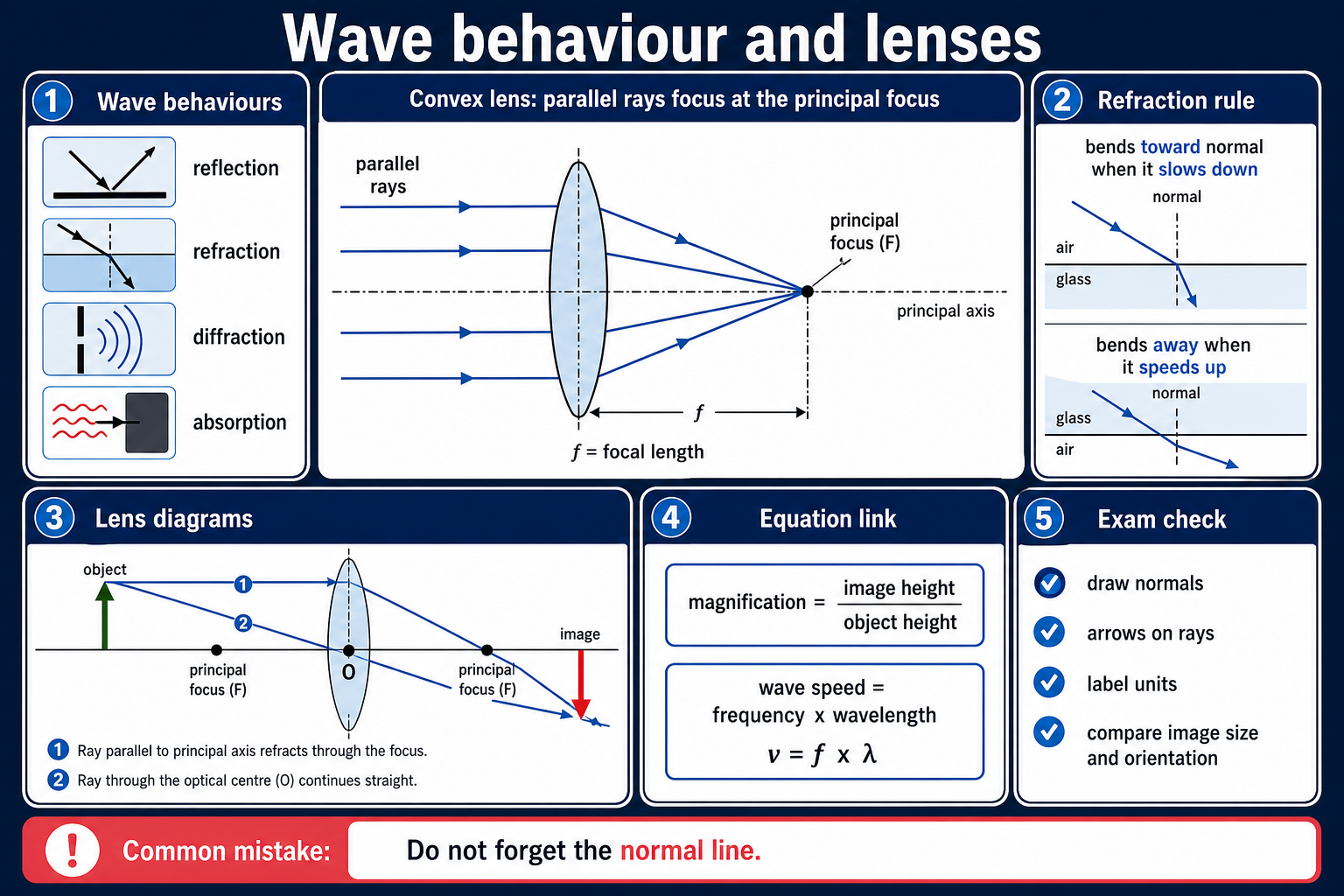
Wave behaviour and lenses infographic
Clear explanation
Reflection happens when a wave bounces from a boundary. The angle of incidence equals the angle of reflection, measured from the normal.
Refraction happens when a wave changes speed at a boundary, often changing direction. Light bends towards the normal when it slows down entering a denser medium.
Diffraction is spreading when waves pass through a gap or around an obstacle. It is strongest when the gap is similar in size to the wavelength.
Key diagram
Worked examples
Mirror reflection
A ray hits a mirror at 35 degrees to the normal.
Angle of incidence = angle of reflection.
The reflected ray is also 35 degrees to the normal.
Quick checks
Choose an answer, then check your thinking.
1. Angles of incidence and reflection are measured from which line?
2. When is diffraction strongest?
Practice questions
Question 1
A ray hits a plane mirror at 42 degrees to the normal. State the angle of reflection.
Reveal answer and marking guidance
Answer: 42 degrees.
Marking: Credit equal angles measured from the normal.
Question 2
Why does light refract entering glass from air?
Reveal answer and marking guidance
Answer: It changes speed at the boundary, so it changes direction.
Marking: Credit change in speed and direction.
Question 3
What happens to water waves passing through a narrow gap?
Reveal answer and marking guidance
Answer: They spread out by diffraction.
Marking: Credit spreading and link to gap size where possible.
Question 4
What does a converging lens do to parallel rays of light?
Reveal answer and marking guidance
Answer: It brings them together at a focus.
Marking: Credit convergence to the focal point.
Practice ladder
Answers and marking guidance
The exact practice answers are hidden under each question so you can try first. For this lesson, marks come from using the correct physics model, choosing the right equation where needed, keeping units with values, and explaining changes with precise words such as transfer, resultant force, acceleration, evidence and uncertainty.
Common mistakes
- Measuring reflection angles from the surface instead of the normal.
- Saying refraction is caused by frequency changing.
- Forgetting diffraction can happen with any wave type.
- Drawing lens rays that bend before they reach the lens.
Extension challenge
Draw a labelled ray diagram for a converging lens and describe how the focal length could be estimated.
Reveal answer
Example answer: A strong extension response names the physics model, uses accurate units and explains why the evidence supports the conclusion.
Exam-board guidance
Short board notes only. Learn the core physics above first.
AQA GCSE Physics
AQA GCSE Physics: often rewards clear physics explanations, correct equations, units and practical evidence for reflection, refraction, diffraction and lenses.
OCR GCSE Physics
OCR GCSE Physics: often values precise definitions, clear working, graph interpretation and links between models and evidence.
Pearson Edexcel GCSE Physics
Pearson Edexcel GCSE Physics: often combines the concept with equation use, data handling and practical interpretation.
Eduqas GCSE Physics
Eduqas GCSE Physics: learn the core explanation and practise applying it to unfamiliar contexts, data and practical questions.
WJEC Wales
WJEC Wales: often expects accurate terms, units and evidence-based explanations using the shared physics idea.
CCEA GCSE Physics
CCEA GCSE Physics: connect the idea to your current unit and use the same practical method language your class uses.
Next lesson
Next, continue with Nuclear Equations and Half-Life.