
Space physics
Lesson overview
This lesson introduces the core physics idea, the useful equipment and the calculation or data skills used on this page.
What you will learn
Star life-cycle cards supplied on this page
Use the nebula, main sequence, red giant, supernova and remnant cards to practise ordering star stages.
Life cycle of stars infographic
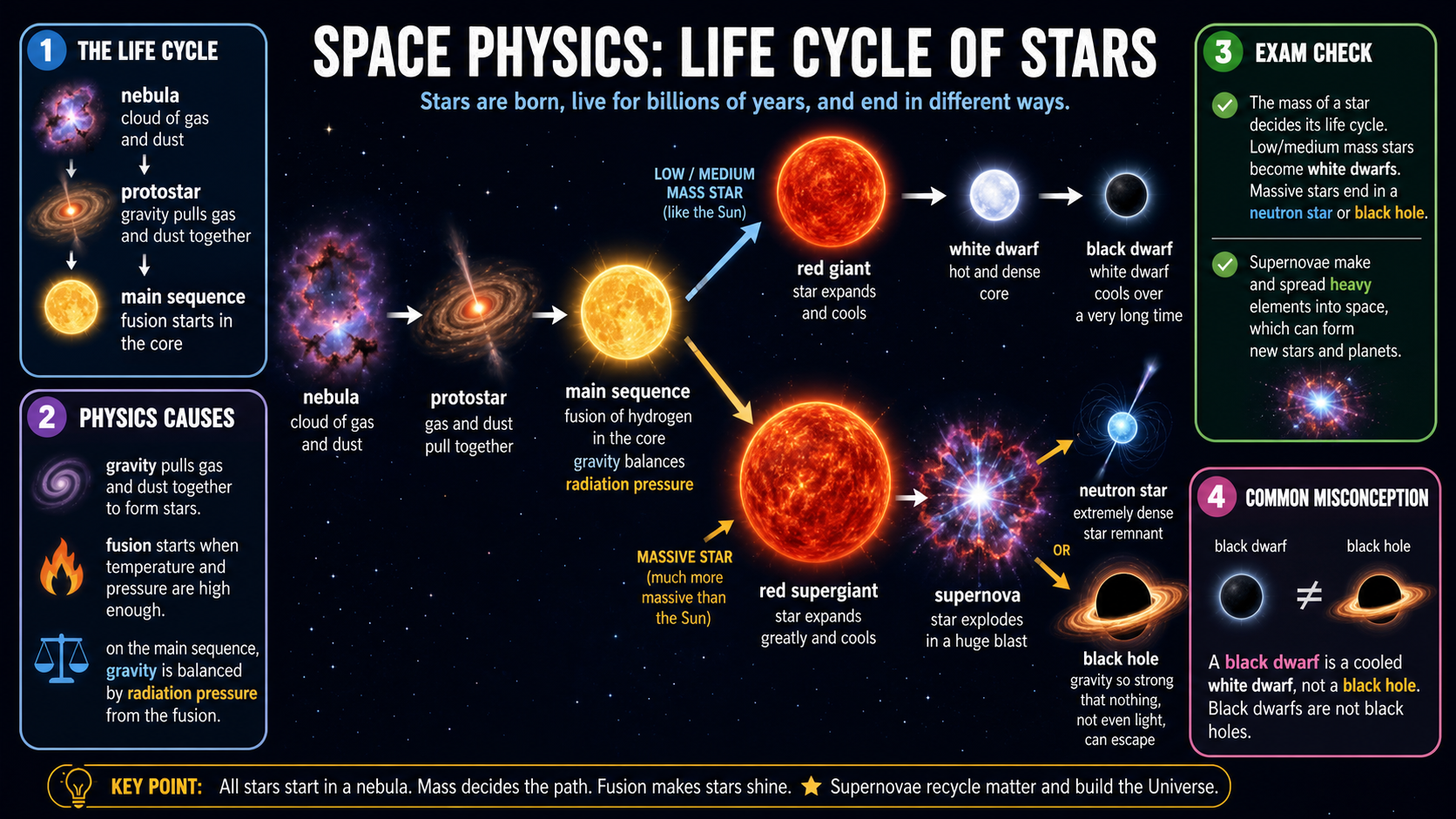
Clear explanation
Stars form when clouds of dust and gas are pulled together by gravity. As the material compresses, temperature rises until nuclear fusion can begin.
During the main sequence, inward gravitational forces are balanced by outward pressure from fusion processes. This stable stage can last a very long time.
Sun-like stars become red giants and then white dwarfs. Very massive stars can become red supergiants, explode as supernovae and leave neutron stars or black holes.
Key diagram
Worked examples
Main sequence stability
Gravity pulls material inwards.
Fusion processes create outward pressure.
The star remains stable when these effects balance.
Quick checks
Choose an answer, then check your thinking.
1. What process releases energy in main sequence stars?
2. What can a very massive star leave after a supernova?
Practice questions
Question 1
What pulls dust and gas together to form a protostar?
Reveal answer and marking guidance
Answer: Gravity.
Marking: Credit gravitational attraction.
Question 2
Name the stable stage of a star's life.
Reveal answer and marking guidance
Answer: Main sequence.
Marking: Credit main sequence.
Question 3
What is the likely final remnant of a Sun-like star?
Reveal answer and marking guidance
Answer: A white dwarf.
Marking: Credit white dwarf after red giant stage.
Question 4
Why can a supernova produce heavy elements?
Reveal answer and marking guidance
Answer: Extreme conditions in the explosion allow heavier nuclei to form and spread into space.
Marking: Credit heavy elements formed and dispersed by supernova.
Practice ladder
Answers and marking guidance
The exact practice answers are hidden under each question so you can try first. For this lesson, marks come from using the correct physics model, choosing the right equation where needed, keeping units with values, and explaining changes with precise words such as transfer, resultant force, acceleration, evidence and uncertainty.
Common mistakes
- Calling fusion ordinary burning.
- Putting white dwarf before main sequence.
- Saying all stars become black holes.
- Forgetting gravity in star formation.
Extension challenge
Draw two life-cycle routes side by side: one for a Sun-like star and one for a massive star.
Reveal answer
Example answer: A strong extension response names the physics model, uses accurate units and explains why the evidence supports the conclusion.
Exam-board guidance
Short board notes only. Learn the core physics above first.
AQA GCSE Physics
AQA GCSE Physics: often rewards clear physics explanations, correct equations, units and practical evidence for stellar life cycles and fusion.
OCR GCSE Physics
OCR GCSE Physics: often values precise definitions, clear working, graph interpretation and links between models and evidence.
Pearson Edexcel GCSE Physics
Pearson Edexcel GCSE Physics: often combines the concept with equation use, data handling and practical interpretation.
Eduqas GCSE Physics
Eduqas GCSE Physics: learn the core explanation and practise applying it to unfamiliar contexts, data and practical questions.
WJEC Wales
WJEC Wales: often expects accurate terms, units and evidence-based explanations using the shared physics idea.
CCEA GCSE Physics
CCEA GCSE Physics: connect the idea to your current unit and use the same practical method language your class uses.
Next lesson
Next, continue with Practical: Density.