
Lesson overview
Convert between denary numbers and binary using powers of two place values.
Focus: Binary and denary conversion.
What you will learn
- Explain why computers represent data using binary.
- Read binary place values as powers of two.
- Convert an 8-bit binary number into denary.
- Convert a small denary number into binary.
Before you start
- Place value in denary numbers.
- Addition of small whole numbers.
- Confidence reading tables.
Binary place-value table
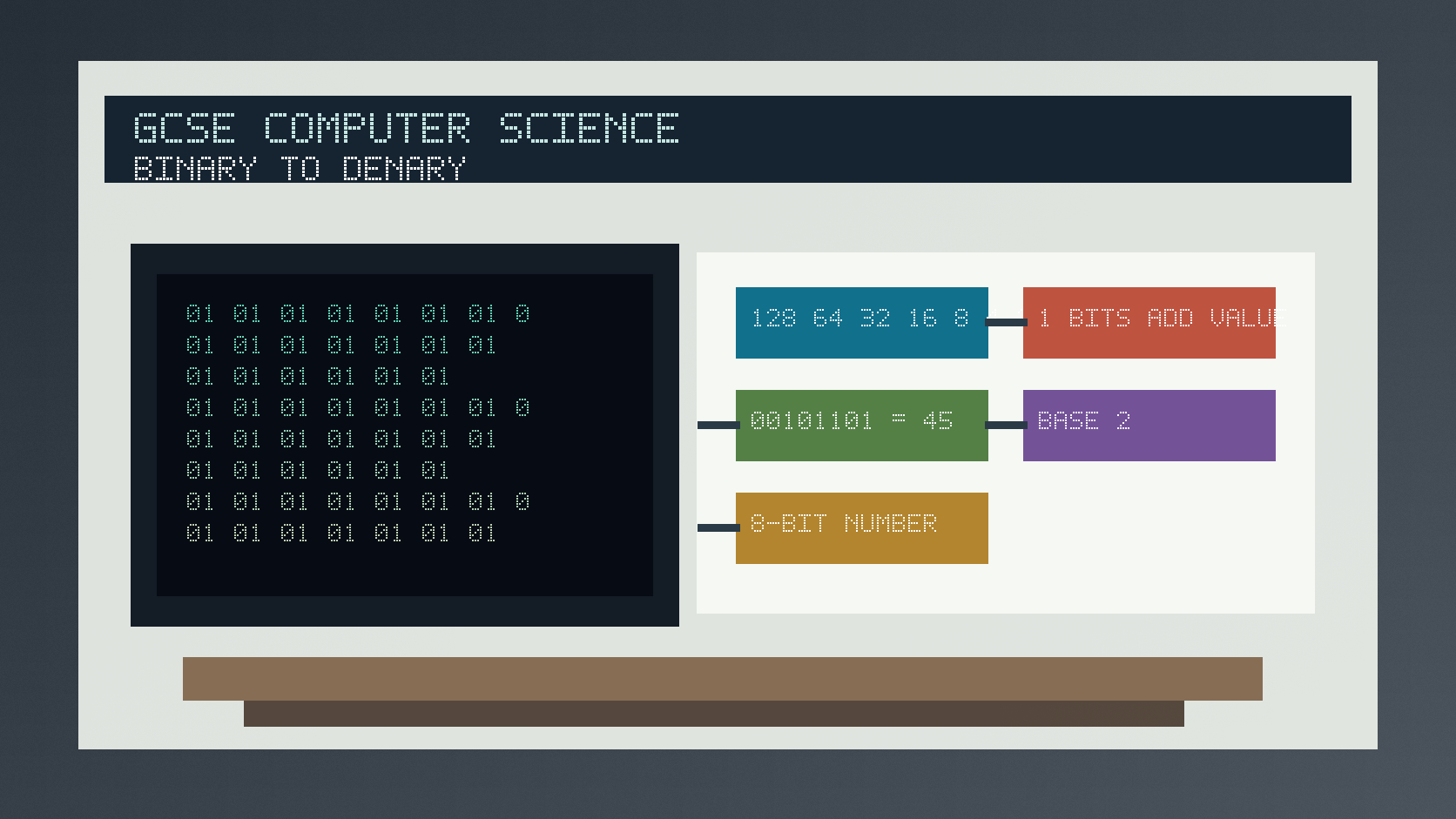
Use the 128, 64, 32, 16, 8, 4, 2, 1 place-value row to convert the example numbers below.
Binary and denary conversion infographic
Explanation
Binary is base 2, so each place has a value that doubles as you move left. In an 8-bit number, the place values are 128, 64, 32, 16, 8, 4, 2 and 1.
To convert binary to denary, add the place values where the bit is 1. Bits with 0 do not add anything.
To convert denary to binary, choose the largest place value you can use, subtract it, and continue across the table.
Worked examples
Converting 00101101 to denary
The 1 bits are in the 32, 8, 4 and 1 columns.
Add those place values.
32 + 8 + 4 + 1 = 45.
Answer: 00101101 is 45 in denary.
Quick checks
1. What is the rightmost place value in binary?
- a. 2
- b. 1
- c. 10
Reveal answer
Answer: b. Correct. The rightmost bit represents one.
Not quite. Binary place values are powers of two starting at 1.
2. What does a 0 bit contribute to the denary total?
- a. The column value
- b. Always 10
- c. Nothing
Reveal answer
Answer: c. Correct. Only 1 bits add their place value.
Not quite. A 0 means that place value is not included.
Practice
1. Convert 00001010 to denary.
Reveal answer
Answer: 10.
Marking: Credit 8 + 2.
2. Convert 00001111 to denary.
Reveal answer
Answer: 15.
Marking: Credit 8 + 4 + 2 + 1.
3. Convert denary 6 to 8-bit binary.
Reveal answer
Answer: 00000110.
Marking: Credit 4 + 2 with leading zeros.
4. Why are leading zeros often shown in 8-bit binary?
Reveal answer
Answer: They show the full number of bits while not changing the value.
Marking: Credit fixed width and unchanged numeric value.
Exam practice ladder
- Fluency: recall the key term and use it accurately.
- Application: apply the idea to the scenario rather than giving a generic definition.
- Algorithmic reasoning: show the steps, condition or variable change clearly.
- Evaluation: explain why one method, structure or control is suitable.
Answers and marking guidance
Exact answers and marking guidance are hidden under each question. For this lesson, earn marks by naming the correct Computer Science idea, applying it to the scenario and showing the logic or value change clearly.
Common mistakes
- Using denary place values such as hundreds, tens and ones.
- Forgetting the 1 column on the far right.
- Adding columns with 0 bits.
- Dropping leading zeros when the question asks for 8-bit binary.
Extension
Convert 93 into 8-bit binary, then convert your answer back to denary to check it.
Next lesson
Next, continue with Hexadecimal Conversion.
Exam-board guidance
Aplailasain is an independent learning resource and is not endorsed by any exam board.
AQA GCSE Computer Science
AQA GCSE Computer Science: this skill supports problem solving, clear algorithms and accurate programming explanations.
OCR GCSE Computer Science
OCR GCSE Computer Science: expect precise algorithm reasoning, trace work and careful use of programming vocabulary.
Pearson Edexcel GCSE Computer Science
Pearson Edexcel GCSE Computer Science: practise explaining the method as well as giving the final answer or code.
Eduqas GCSE Computer Science
Eduqas GCSE Computer Science: secure the transferable idea first, then check how your class applies it in tasks.
WJEC Wales
WJEC Wales: use accurate terminology and show enough working for the examiner to follow your logic.
CCEA
CCEA: connect the idea to your class route and use the same algorithm, programming or systems vocabulary your teacher uses.