
Lesson overview
A practical rates skill for journeys, materials and forces.
Compound measures combine two different measurements into one rate or comparison. The main skill is choosing the correct formula, keeping units consistent and rearranging carefully.
What you will learn
Key facts before you start
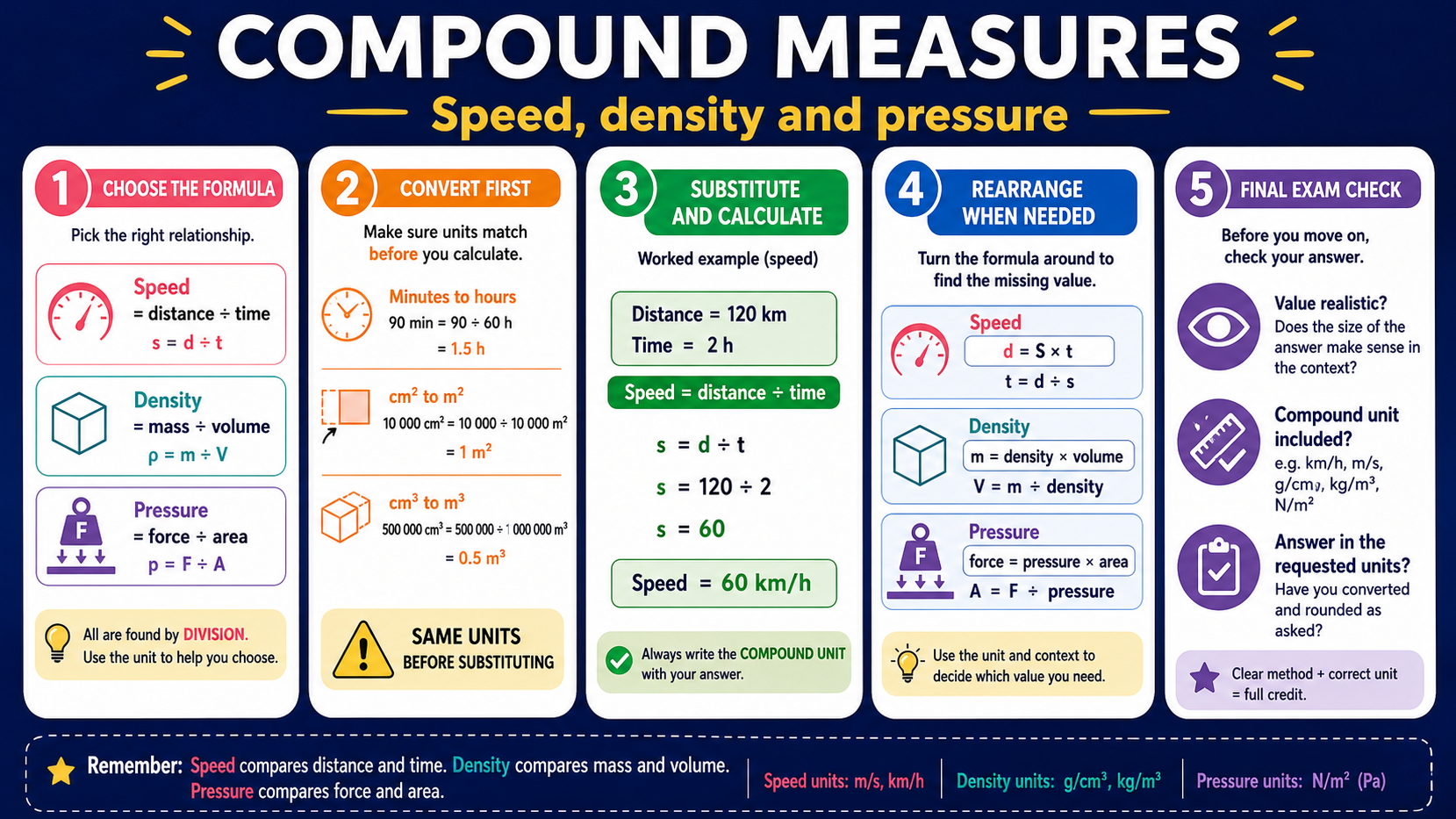
Compound measures speed density and pressure infographic
Before viewing
Before viewing, identify the two units being combined in each formula.
After viewing
After viewing, choose whether a question needs speed, density or pressure and state the units.
Why this matters
Compound measures appear in everyday and scientific situations: average speed for journeys, density for materials, and pressure from forces acting on surfaces.
These questions are usually built from simple division. The challenge is spotting which quantities are being compared and making sure the units match the calculation.
Prior knowledge
You should already be comfortable with:
Clear explanation
What a compound measure is
A compound measure compares two different measurements. The unit often tells you the calculation. For example, km/h means kilometres per hour, so it compares distance with time.
Formula triangles
Formula triangles can be useful if you read them carefully: cover the quantity you want, then use the operation that remains.
For example, speed = distance ÷ time, distance = speed × time, and time = distance ÷ speed.
Unit awareness
Keep the units consistent before calculating. If distance is in km and time is in hours, speed is in km/h. If distance is in metres and time is in seconds, speed is in m/s.
For density, g/cm³ means grams per cubic centimetre, while kg/m³ means kilograms per cubic metre. For pressure, N/m² means newtons per square metre.
Convert both parts of a compound unit when needed. For example, 75 minutes is 1.25 hours, and 600 cm² is 0.06 m² because area units are squared.
Cubed units need the same care. Since 1 cm³ is 0.000001 m³ and 1 g is 0.001 kg, 1 g/cm³ = 1000 kg/m³. This is a more demanding density conversion.
Worked examples
Example 1: Find speed
A car travels 150 km in 3 hours. Find its average speed.
speed = distance ÷ time speed = 150 ÷ 3 = 50Reveal answer
Answer: 50 km/h.
Example 2: Find distance
A cyclist travels at 6 m/s for 40 seconds. Find the distance travelled.
distance = speed × time distance = 6 × 40 = 240Reveal answer
Answer: 240 m.
Example 3: Find density
A block has mass 96 g and volume 12 cm³. Find its density.
density = mass ÷ volume density = 96 ÷ 12 = 8Reveal answer
Answer: 8 g/cm³.
Example 4: Find pressure
A force of 300 N acts on an area of 0.5 m². Find the pressure.
pressure = force ÷ area pressure = 300 ÷ 0.5 = 600Reveal answer
Answer: 600 N/m².
Example 5: Convert a density
A liquid has density 1.2 g/cm³. Convert this density to kg/m³.
1 g/cm³ = 1000 kg/m³ 1.2 × 1000 = 1200Reveal answer
Answer: 1200 kg/m³.
Quick checks
Choose an answer, then check your thinking.
1. A runner travels 400 m in 50 seconds. What is the average speed?
2. A cube has mass 45 g and volume 5 cm³. What is its density?
3. A force of 120 N acts on an area of 6 m². What is the pressure?
Practice questions
Question 1
A train travels 180 km in 2.5 hours. Find its average speed in km/h.
Reveal answer and marking guidance
Answer: 72 km/h.
Marking: speed = distance ÷ time = 180 ÷ 2.5 = 72.
Question 2
A vehicle travels at 15 m/s for 12 seconds. Find the distance travelled.
Reveal answer and marking guidance
Answer: 180 m.
Marking: distance = speed × time = 15 × 12 = 180.
Question 3
A metal object has mass 312 g and volume 40 cm³. Find its density in g/cm³.
Reveal answer and marking guidance
Answer: 7.8 g/cm³.
Marking: density = mass ÷ volume = 312 ÷ 40 = 7.8.
Question 4
A material has density 650 kg/m³ and volume 4 m³. Find its mass.
Reveal answer and marking guidance
Answer: 2600 kg.
Marking: mass = density × volume = 650 × 4 = 2600, with kg as the unit because the density is in kg/m³.
Question 5
A force of 540 N acts on an area of 9 m². Find the pressure in N/m².
Reveal answer and marking guidance
Answer: 60 N/m².
Marking: pressure = force ÷ area = 540 ÷ 9 = 60.
Question 6
A pressure of 35 N/m² acts over an area of 8 m². Find the force.
Reveal answer and marking guidance
Answer: 280 N.
Marking: force = pressure × area = 35 × 8 = 280.
Question 7
A coach travels 90 km in 75 minutes. Find its average speed in km/h.
Reveal answer and marking guidance
Answer: 72 km/h.
Marking: 75 minutes = 1.25 hours, so speed = 90 ÷ 1.25 = 72 km/h.
Question 8
A force of 240 N acts on an area of 600 cm². Find the pressure in N/m².
Reveal answer and marking guidance
Answer: 4000 N/m².
Marking: 600 cm² = 0.06 m². Pressure = force ÷ area = 240 ÷ 0.06 = 4000 N/m². Do not divide by 600 because the required area unit is m².
Question 9
A liquid has density 0.85 g/cm³. Convert this density to kg/m³.
Reveal answer and marking guidance
Answer: 850 kg/m³.
Marking: Use 1 g/cm³ = 1000 kg/m³, so 0.85 × 1000 = 850. The factor is 1000 because both the mass unit and the cubed length unit change.
Question 10
Two delivery vans travel the same route. Van A travels 96 km in 1 hour 20 minutes. Van B travels 54 km in 45 minutes. Which van has the greater average speed?
Reveal answer and marking guidance
Answer: The vans have the same average speed, 72 km/h.
Marking: Convert the times to hours: 1 hour 20 minutes = 1⅓ hours and 45 minutes = 0.75 hours. Van A: 96 ÷ 1⅓ = 72 km/h. Van B: 54 ÷ 0.75 = 72 km/h.
Answers and marking guidance
The exact practice answers are hidden under each question so you can try first. For compound measures, marks usually come from selecting the right formula triangle or rearrangement, substituting the correct quantities, converting units before calculating when needed, and writing the compound unit such as km/h, g/cm³, kg/m³ or N/m². In multi-step questions, show the unit conversion separately so the examiner can follow the method.
Common mistakes
- Mixing units: do not combine metres with hours unless that is the unit you want.
- Using the wrong operation: speed, density and pressure are all found by division.
- Dropping the compound unit: 12 on its own is not as clear as 12 m/s or 12 g/cm³.
- Confusing mass and volume: density compares how much mass is packed into each unit of volume.
- Ignoring area in pressure: the same force gives a larger pressure when the area is smaller.
Extension challenge
A block has density 2.7 g/cm³ and mass 189 g. Find its volume.
Reveal answer
Answer: 70 cm³.
volume = mass ÷ density = 189 ÷ 2.7 = 70.
Exam-board guidance
Compound measures are common across GCSE Maths. Expect questions involving formulae, rearranging, rates, measures, unit conversion, practical contexts and checks that the answer is realistic.
AQA GCSE Maths
Focus on the shared method, notation and checking habit; wording and context can vary by route.
OCR GCSE Maths
Show clear method steps and use precise notation; question wording may vary by route.
Pearson Edexcel GCSE Maths
Keep working visible and check units or notation; contexts may vary by route.
Eduqas GCSE Maths
Use the same core skill in practical contexts, with clear reasoning and final checks.
WJEC Wales
Connect the method to the context and state what the result means.
CCEA GCSE Maths
Make each method step visible and keep notation, units and final checks clear.
Next lesson
Next, build on compound measures with Rates of Change and Units.