
Lesson overview
Conditional Probability is part of GCSE Maths Probability.
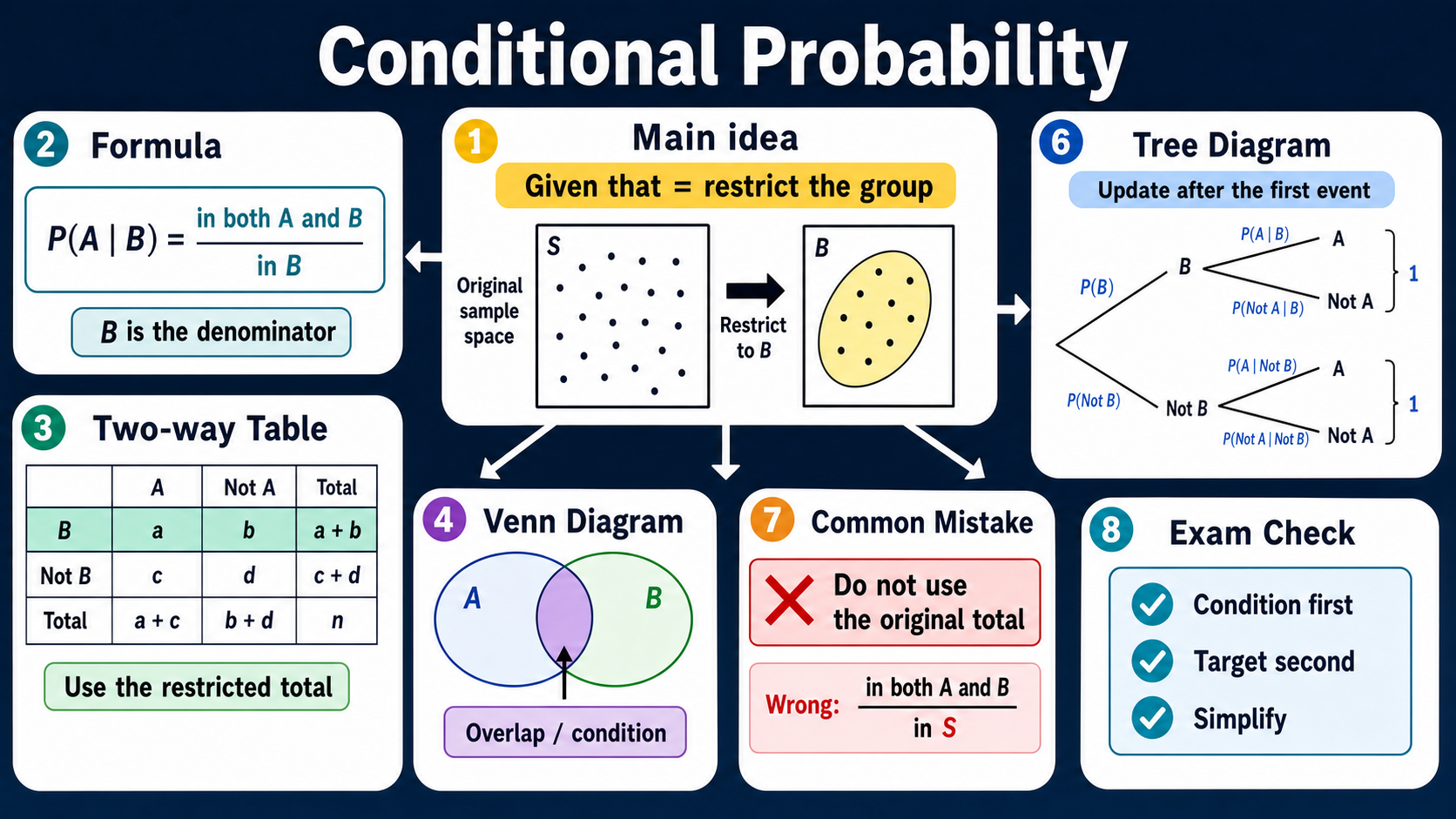
Conditional probability appears when extra information is already known, so the possible outcomes have been narrowed. GCSE questions may use tables, tree diagrams, Venn diagrams or the phrase given that.
What you will learn
Key facts before you start
Conditional probability infographic
Before viewing
Before viewing, identify what information is already known and how it changes the sample space.
After viewing
After viewing, calculate one conditional probability after reducing the possible outcomes.
Why this matters
Conditional probability stops you using the wrong total. Once a condition is known, the denominator is the restricted group, not the original population.
Prior knowledge
You should already be comfortable with:
Clear explanation
Main idea
Conditional probability means the total group has changed because you already know something. If you know a pupil is in Year 11, only Year 11 pupils belong in the denominator.
Method
In a two-way table, choose the row or column named by the condition first. In a tree diagram, move along the branch that has already happened, then use the probabilities from that point.
In a Venn diagram, the condition names the circle or region you are allowed to use as the denominator. The event asked for is the part of that restricted region that also matches the question.
Be careful with reversed wording. P(first red given second green) is not automatically the same as P(second green given first red); count the cases that match the stated condition.
With notation, P(A | B) means probability of A given B. The event after the vertical bar is the condition, so it decides the denominator.
Conditions can also use complement language such as not in a club, outside the circle or did not choose swimming. In those questions, build the restricted group from the people or outcomes that are left after excluding the named event.
Answer tip
The phrase given that is a strong signal for conditional probability. Read it as: restrict the sample space before calculating.
Worked examples
Table condition
In a class, 12 of 20 girls study art. Given that a pupil is a girl, find P(art).
Reveal answer
Answer: The condition is girl, so the denominator is 20 girls, not the whole class. P(art | girl) = 12/20 = 3/5.
Restricted outcomes
A fair dice is rolled. Given that the result is even, find the probability that it is greater than 3.
Reveal answer
Answer: The even outcomes are 2, 4, 6. Of these, 4 and 6 are greater than 3, so the probability is 2/3.
Complement condition
In a group of 40 pupils, 18 study science and 22 study maths. 10 pupils study both. Given that a pupil does not study science, find P(studies maths).
Reveal answer
Answer: Not science gives 40 − 18 = 22 pupils. Maths but not science gives 22 − 10 = 12 pupils. The conditional probability is 12/22 = 6/11.
Quick checks
Choose an answer, then check your thinking.
1. A question says “given that the pupil is in Year 10”. Which total should you use?
2. Given that a dice roll is odd, what are the possible outcomes?
Practice questions
Question 1
Given that a card from a standard pack is red, identify the restricted set and find the probability that the card is a heart.
Reveal answer and marking guidance
Answer: 1/2.
Marking: There are 26 red cards and 13 hearts, so 13/26 = 1/2.
Question 2
Given that a dice roll is even, list the possible outcomes in the restricted sample space and find the probability that it is 6.
Reveal answer and marking guidance
Answer: 1/3.
Marking: Even outcomes are 2, 4 and 6, so 1 of the 3 possible outcomes is 6.
Question 3
In a group of 30 pupils, 18 are boys. 6 of the boys cycle to school. Given that a pupil is a boy, find P(cycles), making the boy denominator clear.
Reveal answer and marking guidance
Answer: 1/3.
Marking: The condition is boy, so use 18 as the denominator: 6/18 = 1/3.
Question 4
A bag has 3 red counters and 5 blue counters. Two counters are taken without replacement. Given that the first counter is red, find P(second counter is blue).
Reveal answer and marking guidance
Answer: 5/7.
Marking: After one red is removed, 7 counters remain and all 5 blue counters are still in the bag.
Question 5
A club has 18 junior members and 22 senior members. 10 juniors and 8 seniors chose swimming. Given that a member chose swimming, find the probability that the member is junior.
Reveal answer and marking guidance
Answer: 5/9.
Marking: The condition is chose swimming, so the denominator is 10 + 8 = 18 swimmers. The numerator is 10 juniors, so 10/18 = 5/9.
Question 6
In a year group, 24 pupils study French, 18 study German and 10 study both. Given that a pupil studies German, find the probability that the pupil also studies French.
Reveal answer and marking guidance
Answer: 5/9.
Marking: The German group is the restricted denominator, so use 18. The overlap with French is 10, so 10/18 = 5/9.
Question 7
In a two-way table, 14 pupils play football, 11 pupils play netball, and 6 pupils play both sports. Given that a pupil plays football, find the probability that the pupil also plays netball.
Reveal answer and marking guidance
Answer: 3/7.
Marking: The condition is plays football, so the denominator is 14. The overlap is 6, so 6/14 = 3/7.
Question 8
A bag contains 4 red, 3 blue and 2 green counters. Two counters are taken without replacement. Given that the second counter is green, find the probability that the first counter was red.
Reveal answer and marking guidance
Answer: 1/2.
Marking: Count successful ordered pairs. Red then green gives 4 × 2 = 8 ordered pairs. Any first colour then green gives 8 possible first counters for each green second, so 8 × 2 = 16 ordered pairs. The probability is 8/16 = 1/2.
Question 9
In a group of 50 pupils, 28 study geography, 24 study history and 14 study both. Given that a pupil does not study history, find the probability that the pupil studies geography.
Reveal answer and marking guidance
Answer: 7/13.
Marking: Not history gives 50 − 24 = 26 pupils. Geography but not history gives 28 − 14 = 14 pupils. Use the restricted denominator: 14/26 = 7/13.
Question 10
In a group of 40 pupils, 18 play chess, 16 play tennis and 7 play both. Find P(chess | tennis).
Reveal answer and marking guidance
Answer: 7/16.
Marking: The condition is tennis, because it is after the vertical bar. Use the 16 tennis players as the denominator and the 7 who play both as the numerator.
Answers and marking guidance
The exact practice answers are hidden under each question so you can try first. For conditional probability, marks usually come from stating the condition, using the restricted denominator, selecting the matching numerator, interpreting notation such as P(A | B) and explaining why the original total is no longer the right total.
Common mistakes
- Using the original total: given that narrows the group before you calculate.
- Mixing up the condition and the target event: “given that B” sets the denominator; the probability asked for is usually A within that group.
- Ignoring table direction: check whether the condition names a row, a column or a branch.
- Forgetting changed counts after an event: in without-replacement questions, the known first event changes what remains.
Extension challenge
In a group of 30 pupils, 18 play football, 12 play hockey and 7 play both. Given that a pupil plays football, find the probability that they also play hockey.
Reveal answer
Example answer: The condition reduces the group to the 18 football players. Of these, 7 also play hockey, so the conditional probability is 7/18.
Exam-board guidance
Conditional Probability appears within the shared GCSE Maths probability content used by the supported routes. Exact wording, tiering and calculator expectations can vary, but the core skill is the same: restrict the sample space first, then calculate from the outcomes that are still possible.
AQA GCSE Maths
Focus on the shared method, notation and checking habit; wording and context can vary by route.
OCR GCSE Maths
Show clear method steps and use precise notation; question wording may vary by route.
Pearson Edexcel GCSE Maths
Keep working visible and check units or notation; contexts may vary by route.
Eduqas GCSE Maths
Use the same core skill in practical contexts, with clear reasoning and final checks.
WJEC Wales
Connect the method to the context and state what the result means.
CCEA GCSE Maths
Make each method step visible and keep notation, units and final checks clear.
Next lesson
Next, continue with Product Rule for Counting.