
Lesson overview
Product Rule for Counting is part of GCSE Maths Probability.
The product rule for counting is a GCSE probability and systematic-listing skill. It helps count combined outcomes without writing every possibility, especially for menus, outfits, routes, codes and sample spaces.
What you will learn
Key facts before you start
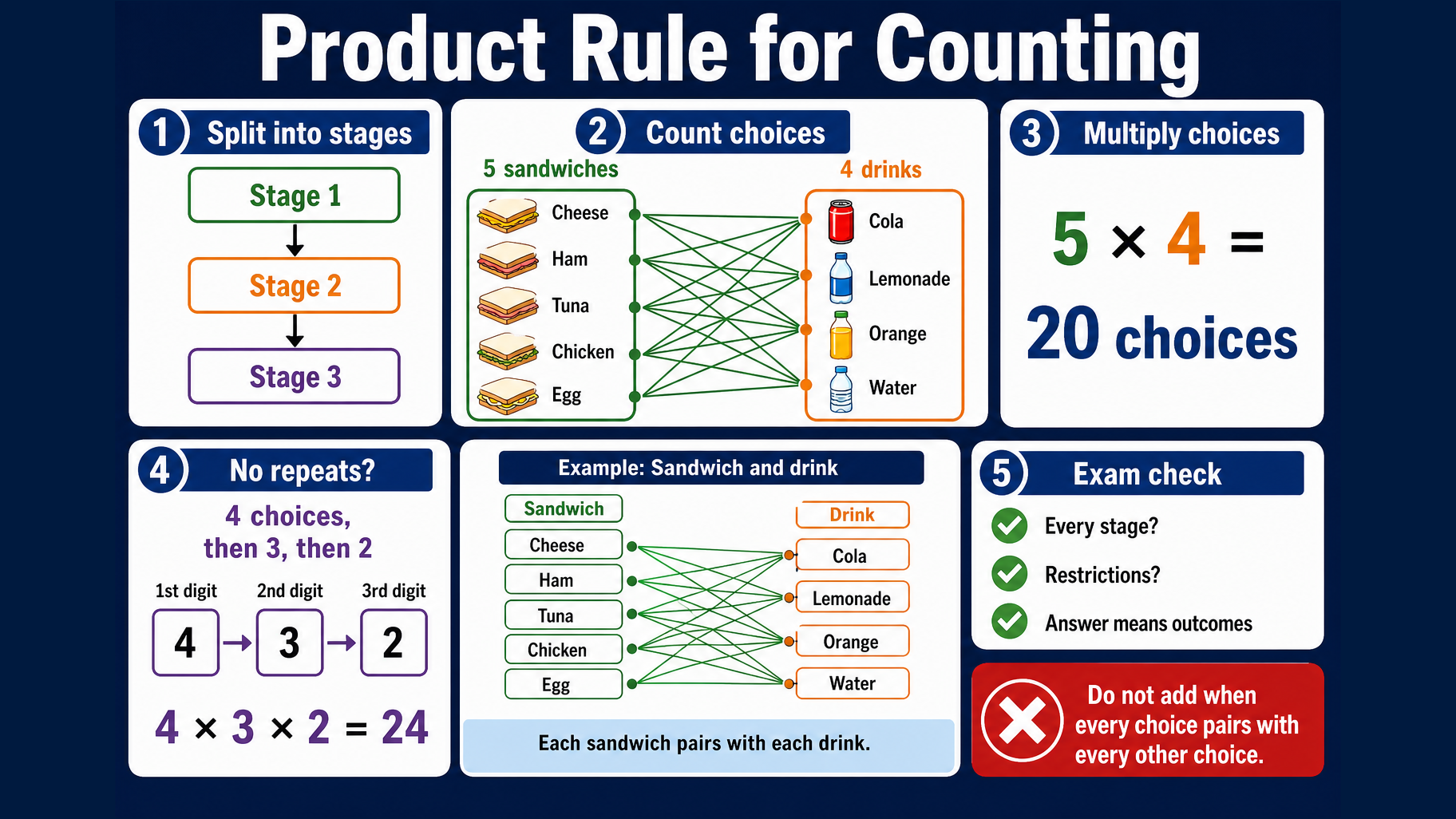
Product rule for counting infographic
Before viewing
Before viewing, count the choices at each stage before multiplying.
After viewing
After viewing, write one product-rule calculation and explain each factor.
Why this matters
Systematic counting helps with probability, passwords, menus and sample spaces when listing everything would take too long. It also helps you build the correct denominator for equally likely outcomes.
Prior knowledge
You should already be comfortable with:
Clear explanation
Main idea
If there are 3 choices for the first stage and 4 choices for the second stage, each first choice can pair with every second choice. There are 3 × 4 = 12 combined outcomes.
Method
For more stages, keep multiplying the number of choices at each stage. Restrictions change the number of choices at the affected stage, so decide the stages before multiplying.
Check whether order matters. For a code, AB and BA are usually different. For choosing two team members, the same two names may count once unless the question gives different roles.
For at-least-one questions, a complement is often cleaner: count all possible outcomes, subtract the outcomes with none of the required feature, then keep what remains.
Role wording matters. Choosing a captain and a vice-captain is ordered because swapping the names changes the jobs; choosing two ordinary team members is usually unordered and needs extra care to avoid counting each pair twice.
Answer tip
Words such as different, no repeats, must include or starts with are restrictions. They often mean a later stage has fewer choices than the first stage.
Worked examples
Menu choices
A meal has 4 mains and 3 desserts. How many meal combinations are possible?
Reveal answer
Answer: 4 choices for the main and 3 choices for the dessert, so 4 × 3 = 12 combinations.
Restricted code
A two-digit code is made from the digits 0 to 9. The digits must be different. How many codes are possible?
Reveal answer
Answer: There are 10 choices for the first digit and then 9 choices left for the second digit, so 10 × 9 = 90 codes.
Ordered roles
A class chooses a captain and a vice-captain from 8 pupils. One pupil cannot have both roles. How many outcomes are possible?
Reveal answer
Answer: There are 8 choices for captain, then 7 choices left for vice-captain. The roles are different, so the order matters: 8 × 7 = 56 outcomes.
Quick checks
Choose an answer, then check your thinking.
1. A cafe has 5 sandwiches and 4 drinks. How many sandwich-and-drink choices are there?
2. A three-letter code uses A, B, C and D with no repeated letters. How many choices are there for the second letter after the first has been chosen?
Practice questions
Question 1
A school uniform shop lets pupils choose 1 of 5 shirts and 1 of 4 pairs of trousers for a display outfit. How many different shirt-and-trouser outfits can be made?
Reveal answer and marking guidance
Answer: 20 outfits.
Marking: 5 × 4 = 20 because each shirt can pair with each pair of trousers.
Question 2
For a set menu, a cafe offers 3 starters, 6 mains and 2 desserts. A customer chooses one item from each stage. How many different meals are possible?
Reveal answer and marking guidance
Answer: 36 meals.
Marking: 3 × 6 × 2 = 36.
Question 3
A locker code is made from two digits chosen from 0-9. The two digits must be different, and a code such as 27 is different from 72. How many codes are possible?
Reveal answer and marking guidance
Answer: 90 codes.
Marking: 10 choices for the first digit, then 9 choices for the second digit: 10 × 9 = 90.
Question 4
A game uses a spinner with 4 equal colours and then flips a fair coin. If the result is recorded as colour followed by heads or tails, how many equally likely combined outcomes are there?
Reveal answer and marking guidance
Answer: 8 combined outcomes.
Marking: 4 × 2 = 8; this total could be used as a probability denominator.
Question 5
A four-digit PIN for a practice question is made from the digits 1, 2, 3, 4, 5 and 6. No digit may be repeated. How many PINs are possible?
Reveal answer and marking guidance
Answer: 360 PINs.
Marking: There are 6 choices, then 5, then 4, then 3, so 6 × 5 × 4 × 3 = 360.
Question 6
A code has one consonant from B, C, D or F, then one vowel from A, E or I, then one digit from 0, 1, 2, 3 or 4. How many codes are possible?
Reveal answer and marking guidance
Answer: 60 codes.
Marking: Multiply the three stages: 4 consonants × 3 vowels × 5 digits = 60.
Question 7
A three-character password uses one letter from A, B, C, D or E, then one digit from 0-9, then one symbol from !, ? or #. How many passwords are possible?
Reveal answer and marking guidance
Answer: 150 passwords.
Marking: There are 5 letter choices, 10 digit choices and 3 symbol choices, so 5 × 10 × 3 = 150.
Question 8
A four-digit code is made from the digits 1, 2, 3, 4 and 5. Repeats are allowed. How many codes contain at least one 5?
Reveal answer and marking guidance
Answer: 369 codes.
Marking: Use the complement. There are 5 × 5 × 5 × 5 = 625 total codes. Codes with no 5 use only 1, 2, 3 and 4, so there are 4 × 4 × 4 × 4 = 256. Therefore at least one 5 gives 625 − 256 = 369.
Question 9
A club chooses a chairperson, secretary and treasurer from 10 members. No member can take more than one role. How many different role assignments are possible?
Reveal answer and marking guidance
Answer: 720 role assignments.
Marking: The roles are ordered, so there are 10 choices for chairperson, 9 left for secretary and 8 left for treasurer: 10 × 9 × 8 = 720.
Question 10
A four-character code is made from the letters A, B, C, D, E and F. No letter may be repeated, and the code must start with A or E. How many codes are possible?
Reveal answer and marking guidance
Answer: 120 codes.
Marking: There are 2 choices for the first letter, then 5, 4 and 3 choices for the remaining positions, so 2 × 5 × 4 × 3 = 120.
Answers and marking guidance
The exact practice answers are hidden under each question so you can try first. For product-rule counting, marks usually come from identifying each stage, multiplying the number of choices, adjusting later stages when restrictions such as no repeats reduce the choices, and using a complement when at least one wording makes direct counting awkward.
Common mistakes
- Adding instead of multiplying: add choices only when choosing one category or another; multiply when making combined choices across stages.
- Ignoring restrictions: no repeats, different digits or fixed starting letters change the number of choices.
- Double counting: check whether AB and BA count as different outcomes in the context.
- Losing the probability link: the count often becomes the denominator for equally likely probability questions.
Extension challenge
A cafe offers 4 sandwich fillings, 3 breads and 5 drinks. Work out the number of possible meal deals, then explain why multiplying is quicker than listing.
Reveal answer
Example answer: There are 4 x 3 x 5 = 60 possible meal deals. Multiplication works because each filling can pair with every bread and every drink.
Exam-board guidance
Product Rule for Counting appears within the shared GCSE Maths probability and systematic-listing content used by the supported routes. Exact wording, tiering and calculator expectations can vary, but the core skill is the same: split the task into stages, count choices at each stage and multiply carefully.
AQA GCSE Maths
Focus on the shared method, notation and checking habit; wording and context can vary by route.
OCR GCSE Maths
Show clear method steps and use precise notation; question wording may vary by route.
Pearson Edexcel GCSE Maths
Keep working visible and check units or notation; contexts may vary by route.
Eduqas GCSE Maths
Use the same core skill in practical contexts, with clear reasoning and final checks.
WJEC Wales
Connect the method to the context and state what the result means.
CCEA GCSE Maths
Make each method step visible and keep notation, units and final checks clear.
Next lesson
Next, continue with Collecting and Classifying Data.