
Lesson overview
Independent and Dependent Events is part of GCSE Maths Probability.
Independent and dependent events appear in GCSE probability when a question asks whether one outcome changes the probability of another. You need to recognise replacement, no replacement and repeated independent trials before multiplying probabilities.
What you will learn
Key facts before you start
Independent and dependent events infographic
Before viewing
Before viewing, decide whether the second probability changes after the first event.
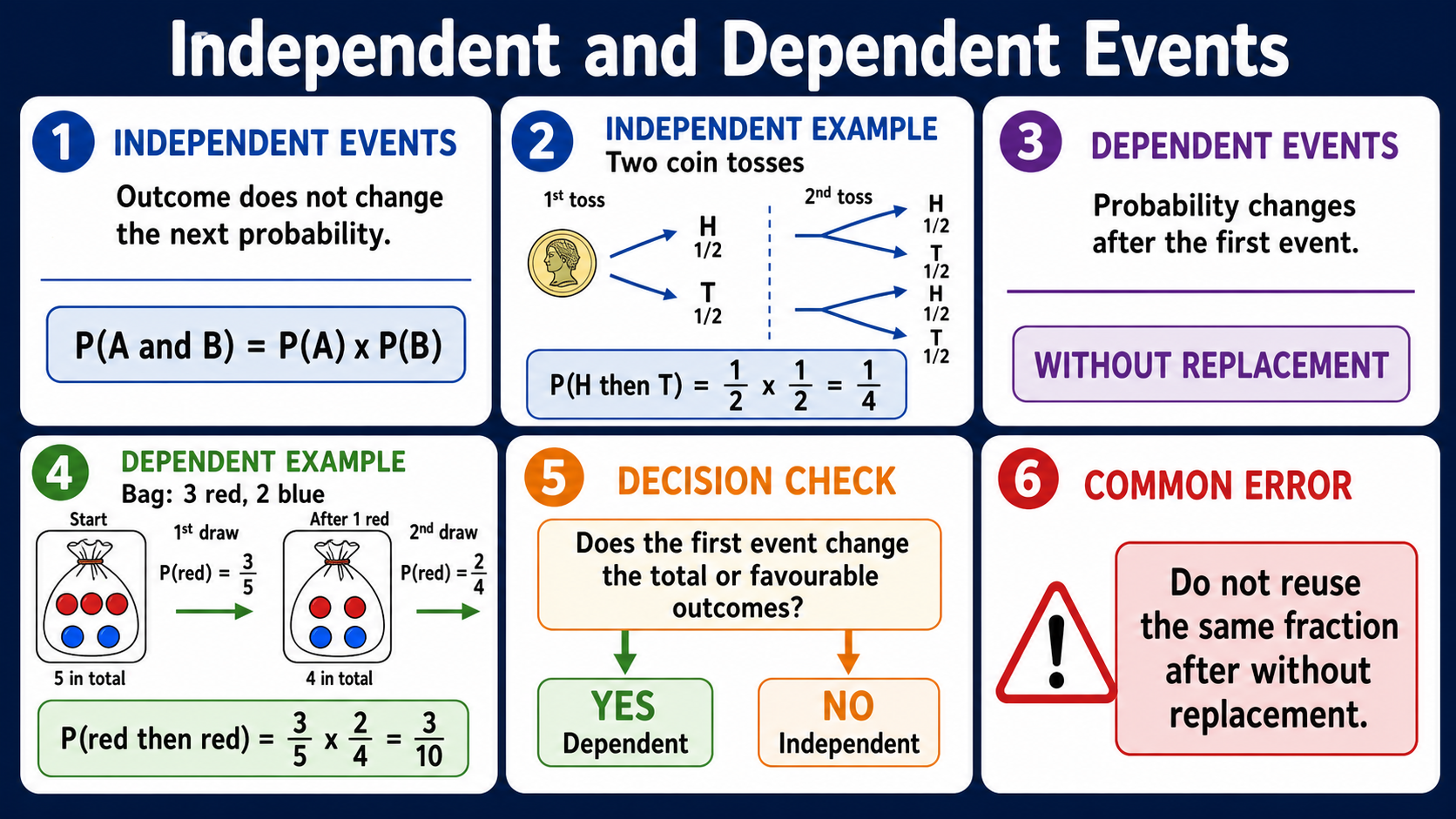
After viewing
After viewing, calculate one independent and one dependent event probability.
Why this matters
Choosing independent or dependent affects every probability calculation after the first event. It is the difference between keeping the same fraction and updating the total.
Prior knowledge
You should already be comfortable with:
Clear explanation
Main idea
Events are independent if one happening does not change the probability of the other. Tossing a coin twice is independent because the second toss is still heads or tails with probability 1/2.
Method
Events are dependent if the first event changes the probability of the second. Taking counters without replacement is dependent because the bag has fewer counters after the first pick.
Independent does not mean equally likely. It only means the probability for the next event has not been changed by what happened before.
For combined events, multiply along the route after deciding whether the second probability stays fixed or changes. If several routes work, multiply each route first, then add the route probabilities.
Words such as exactly one, either order or same colour often mean there is more than one successful route. Write each route separately so you do not add raw branch fractions or miss an order.
For at least one wording, the complement is often shorter: calculate the probability of no successes, then subtract from 1.
Answer tip
Replacement usually makes picks independent; no replacement usually makes them dependent. In a two-stage question, write the first probability, then ask: has the total or the number of successful items changed?
Worked examples
Independent repeated trial
A fair dice is rolled twice. Find P(two sixes).
Reveal answer
Answer: The first roll does not affect the second, so the events are independent: 1/6 × 1/6 = 1/36.
Dependent selection
A bag has 3 red counters and 2 blue counters. Two counters are taken without replacement. Find P(two red).
Reveal answer
Answer: First red: 3/5. Then only 2 red counters remain out of 4 counters, so second red: 2/4. P(two red) = 3/5 × 2/4 = 6/20 = 3/10.
Exactly one route pair
Two independent pupils try a challenge. Sam has probability 0.8 of success and Priya has probability 0.6 of success. Find P(exactly one succeeds).
Reveal answer
Answer: Sam succeeds and Priya does not: 0.8 × 0.4 = 0.32. Sam does not and Priya succeeds: 0.2 × 0.6 = 0.12. Add the two routes: 0.32 + 0.12 = 0.44.
Quick checks
Choose an answer, then check your thinking.
1. A spinner is spun twice. The first spin lands on blue. What happens to the probability of blue on the second spin?
2. Two counters are taken from a bag without replacement. What must you update for the second pick?
Practice questions
Question 1
A fair coin is tossed and a fair dice is rolled. State whether the events are independent and give the reason.
Reveal answer and marking guidance
Answer: Yes, they are independent.
Marking: The coin result does not affect the dice result.
Question 2
A bag has 4 green counters and 6 yellow counters. Two counters are taken without replacement. State whether the events are dependent and explain what changes.
Reveal answer and marking guidance
Answer: Yes, they are dependent.
Marking: The first counter changes how many counters are left for the second pick.
Question 3
P(A) = 0.2 and P(B) = 0.3. A and B are independent events. Write the multiplication for P(A and B), then calculate it.
Reveal answer and marking guidance
Answer: 0.06.
Marking: For independent events, multiply: 0.2 × 0.3 = 0.06.
Question 4
A bag has 5 red counters and 5 blue counters. Two counters are taken without replacement. Find P(two blue counters).
Reveal answer and marking guidance
Answer: 2/9.
Marking: 5/10 × 4/9 = 20/90 = 2/9.
Question 5
A test has P(pass) = 0.75 for each attempt. Two different pupils take the test independently. Find P(both pass).
Reveal answer and marking guidance
Answer: 0.5625.
Marking: The pupils are independent, so multiply 0.75 × 0.75 = 0.5625.
Question 6
A box contains 7 white tiles and 3 black tiles. Two tiles are taken without replacement. Find P(one white then one black).
Reveal answer and marking guidance
Answer: 7/30.
Marking: First white is 7/10. Then 3 black remain out of 9 tiles, so 7/10 × 3/9 = 21/90 = 7/30.
Question 7
A card is chosen from a full shuffled deck, replaced, then another card is chosen. Find P(two aces).
Reveal answer and marking guidance
Answer: 1/169.
Marking: Replacement makes the events independent, so P(ace then ace) = 4/52 × 4/52 = 1/13 × 1/13 = 1/169.
Question 8
A bag has 6 red counters and 4 blue counters. Two counters are taken without replacement. Find P(exactly one blue).
Reveal answer and marking guidance
Answer: 8/15.
Marking: Blue then red is 4/10 × 6/9 = 4/15. Red then blue is 6/10 × 4/9 = 4/15. Add the two successful routes: 8/15.
Question 9
A bag contains 2 red counters and 3 blue counters. Two counters are taken without replacement. Find P(the two counters are the same colour).
Reveal answer and marking guidance
Answer: 2/5.
Marking: Red then red is 2/5 × 1/4 = 1/10. Blue then blue is 3/5 × 2/4 = 3/10. Add the two successful routes: 1/10 + 3/10 = 2/5.
Question 10
A spinner lands on blue with probability 0.35 on each independent spin. It is spun three times. Find P(at least one blue).
Reveal answer and marking guidance
Answer: 0.725375.
Marking: Use the complement. P(no blue) = 0.65 × 0.65 × 0.65 = 0.274625, so P(at least one blue) = 1 − 0.274625 = 0.725375.
Answers and marking guidance
The exact practice answers are hidden under each question so you can try first. For independent and dependent events, marks usually come from identifying whether probabilities stay fixed or change, showing route multiplication, updating totals for no-replacement contexts and using complements or route addition where the wording requires it.
Common mistakes
- Treating without replacement as independent: after an item is removed, the second denominator is usually smaller.
- Changing both counts when only one should change: if the first counter is red, the number of blue counters may stay the same but the total changes.
- Forgetting what AND means: for one route with two events, multiply the probabilities along that route.
- Adding separate routes too soon: multiply each successful route first, then add routes only when there is more than one way to succeed.
Extension challenge
Explain the difference between rolling a fair dice twice and taking two counters from a bag without replacement. Give one probability calculation for each situation.
Reveal answer
Example answer: Dice rolls are independent, so P(two sixes) = 1/6 x 1/6 = 1/36. Without replacement is dependent because the second probability changes after the first counter is removed.
Exam-board guidance
Independent and Dependent Events appears within the shared GCSE Maths probability content used by the supported routes. Exact wording, tiering and calculator expectations can vary, but the core skill is the same: decide whether the first event changes the second probability, show the multiplication and check the context.
AQA GCSE Maths
Focus on the shared method, notation and checking habit; wording and context can vary by route.
OCR GCSE Maths
Show clear method steps and use precise notation; question wording may vary by route.
Pearson Edexcel GCSE Maths
Keep working visible and check units or notation; contexts may vary by route.
Eduqas GCSE Maths
Use the same core skill in practical contexts, with clear reasoning and final checks.
WJEC Wales
Connect the method to the context and state what the result means.
CCEA GCSE Maths
Make each method step visible and keep notation, units and final checks clear.
Next lesson
Next, continue with Conditional Probability.