
Lesson overview
Probability Trees is part of GCSE Maths Probability.
Probability trees organise successive events. They show when to multiply along a route, when to add separate successful routes and when probabilities change after an event.
What you will learn
Key facts before you start
Why this matters
Tree diagrams make two-stage and three-stage probability questions much easier to follow.
Prior knowledge
You should already be comfortable with:
Probability trees infographic
Before viewing
Before viewing, identify one complete route and the probabilities along it.
After viewing
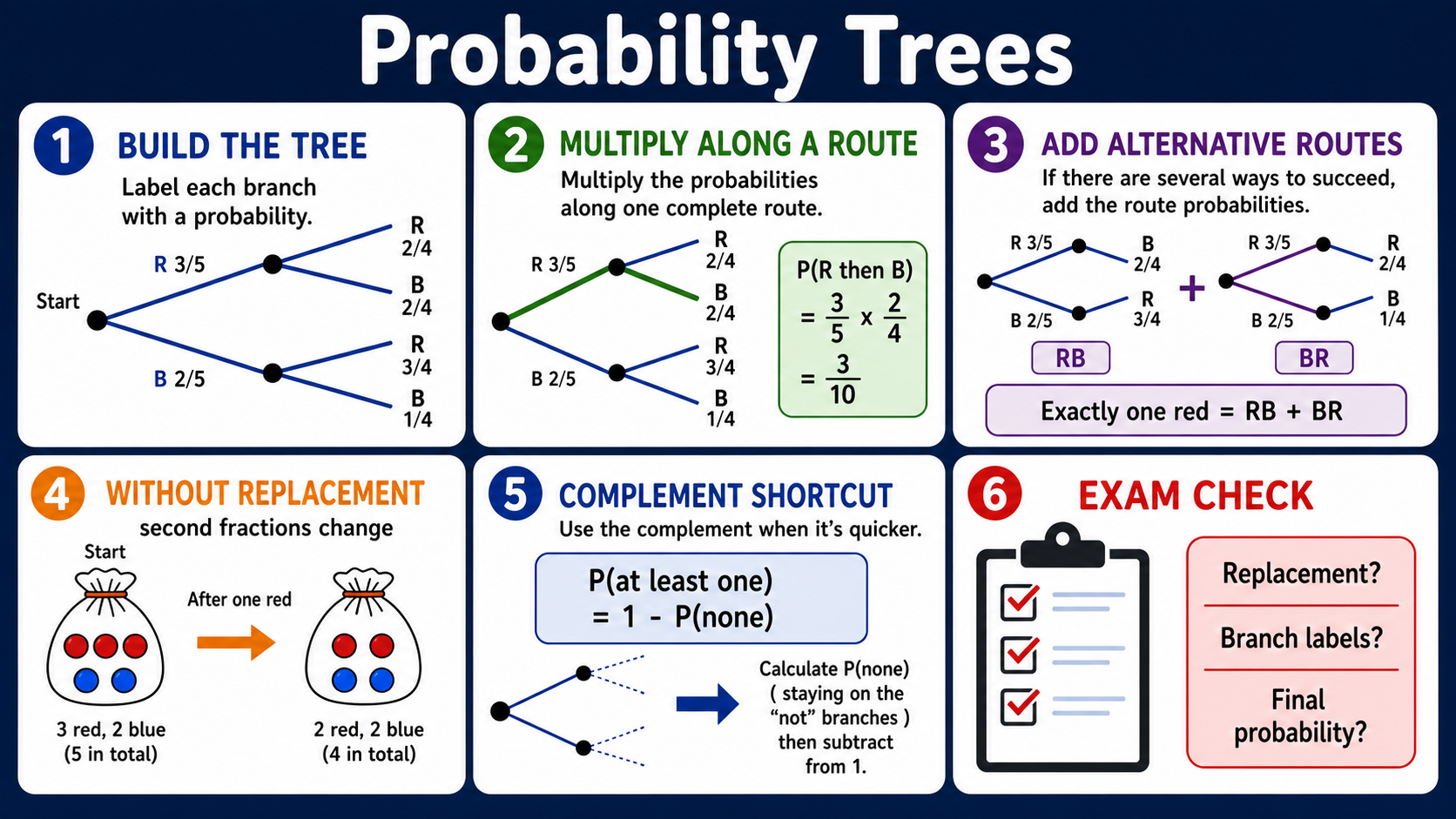
After viewing, multiply along one route and add routes where needed.
Clear explanation
Main idea
For one complete route through a tree, multiply along the branches. If there is more than one successful route, find each route probability first, then add those route probabilities.
Method
With replacement, the second-stage probabilities stay the same. Without replacement, the total goes down and the category counts may change, so the second branch fractions usually change.
For at least one or not both questions, a complement can be quicker: find the probability of the opposite event and subtract it from 1.
If a later part gives information such as the first counter was red, start from the branch that matches that information. Do not keep routes that the condition has ruled out.
For three-stage independent trees, the same rules continue: multiply along one complete route. When many routes count as success, the complement is often cleaner than listing every successful route.
Answer tip
Write the event next to the route you need. For exactly one red, the successful routes are red then blue and blue then red, so both route probabilities must be included.
Worked examples
With replacement
A bag has P(red) = 1/3. Two picks are made with replacement. Find P(two red).
Reveal answer
Answer: 1/3 × 1/3 = 1/9, because the probability resets after the first pick.
Without replacement
A bag has 3 red counters and 2 blue counters. Two counters are picked without replacement. Find P(exactly one red).
Reveal answer
Answer: RB or BR: 3/5 × 2/4 + 2/5 × 3/4 = 3/10 + 3/10 = 3/5.
Three independent trials
A test has three independent attempts, each with P(pass) = 0.7. Find P(at least one pass).
Reveal answer
Answer: Use the complement. P(no passes) = 0.3 × 0.3 × 0.3 = 0.027, so P(at least one pass) = 1 − 0.027 = 0.973.
Quick checks
Choose an answer, then check your thinking.
1. In a tree diagram, what do you do along one route?
2. A counter is not replaced. What usually changes on the second stage?
Practice questions
Question 1
A fair coin is tossed twice. Draw or imagine the HH route on a tree diagram and find P(two heads).
Reveal answer and marking guidance
Answer: 1/4.
Marking: Multiply along the HH route: 1/2 × 1/2 = 1/4.
Question 2
On a tree diagram, P(A) = 0.4 and the branch for P(B after A) = 0.5. Find P(A and B) for that one route.
Reveal answer and marking guidance
Answer: 0.2.
Marking: Multiply along the route: 0.4 × 0.5 = 0.2.
Question 3
A tree diagram has two successful routes with probabilities 0.12 and 0.18. Explain what to do with the two routes, then find the total probability of success.
Reveal answer and marking guidance
Answer: 0.30.
Marking: Add alternative successful routes: 0.12 + 0.18 = 0.30.
Question 4
A bag has 4 red and 1 blue counters. Two counters are picked without replacement. Find P(two red).
Reveal answer and marking guidance
Answer: 3/5.
Marking: First red is 4/5, then red after red is 3/4, so 4/5 × 3/4 = 3/5.
Question 5
A bag has 3 red, 2 blue and 1 green counters. Two counters are picked without replacement. Find P(exactly one blue).
Reveal answer and marking guidance
Answer: 8/15.
Marking: Blue then not blue is 2/6 × 4/5 = 4/15. Not blue then blue is 4/6 × 2/5 = 4/15. Add the routes: 8/15.
Question 6
A biased spinner has P(win) = 0.3 on each spin. It is spun twice independently. Find P(at least one win).
Reveal answer and marking guidance
Answer: 0.51.
Marking: Use the complement: P(no wins) = 0.7 × 0.7 = 0.49, so P(at least one win) = 1 − 0.49 = 0.51.
Question 7
A bag has 5 red and 3 blue counters. Two counters are taken without replacement. Given that the first counter was red, find the probability that the second counter is blue.
Reveal answer and marking guidance
Answer: 3/7.
Marking: The condition puts you on the first red branch. There are then 4 red and 3 blue counters left, 7 in total, so P(blue second | red first) = 3/7.
Question 8
A tree has three independent trials, each with P(success) = 0.2. Find P(at least one success).
Reveal answer and marking guidance
Answer: 0.488.
Marking: Use the complement: P(no successes) = 0.8 × 0.8 × 0.8 = 0.512, so P(at least one success) = 1 − 0.512 = 0.488.
Question 9
A bag has 6 red and 4 blue counters. Two counters are taken without replacement. Given that the two counters are different colours, find the probability that the first counter was red.
Reveal answer and marking guidance
Answer: 1/2.
Marking: Different colours can be RB or BR. P(RB) = 6/10 × 4/9 = 4/15 and P(BR) = 4/10 × 6/9 = 4/15. Given different colours, P(first red) = P(RB) ÷ (P(RB) + P(BR)) = (4/15)/(8/15) = 1/2.
Question 10
A player takes three independent shots. The probability of scoring on each shot is 0.4. Find P(exactly two scores).
Reveal answer and marking guidance
Answer: 0.288.
Marking: There are three successful routes: score-score-miss, score-miss-score and miss-score-score. Each route has probability 0.4 × 0.4 × 0.6 = 0.096, so 3 × 0.096 = 0.288.
Answers and marking guidance
The exact practice answers are hidden under each question so you can try first. For probability trees, marks usually come from drawing or completing the branches correctly, labelling replacement or no-replacement probabilities, multiplying along each route, adding alternative successful routes and simplifying or rounding the final probability as requested.
Common mistakes
- Adding along a route: multiply along one route; add only after route probabilities have been found.
- Forgetting replacement: with replacement probabilities stay the same, but without replacement the second-stage fractions usually change.
- Counting one route for exactly one event: exactly one red means red then not red and not red then red.
- Dropping branch labels: labels make it clear which probability belongs to which route.
Extension challenge
A bag contains 5 red counters and 3 blue counters. Two counters are taken without replacement. Draw the tree and find the probability of two red counters.
Reveal answer
Example answer: First red is 5/8. After a red is taken, 4 red counters remain out of 7, so P(red then red) = 5/8 x 4/7 = 5/14.
Exam-board guidance
Probability Trees appears within shared GCSE probability content. The same core method applies across boards: branch labels first, route calculations second, final probability last, with replacement decisions checked before any arithmetic.
AQA GCSE Maths
Focus on the shared method, notation and checking habit; wording and context can vary by route.
OCR GCSE Maths
Show clear method steps and use precise notation; question wording may vary by route.
Pearson Edexcel GCSE Maths
Keep working visible and check units or notation; contexts may vary by route.
Eduqas GCSE Maths
Use the same core skill in practical contexts, with clear reasoning and final checks.
WJEC Wales
Connect the method to the context and state what the result means.
CCEA GCSE Maths
Make each method step visible and keep notation, units and final checks clear.
Next lesson
Next, continue with Independent and Dependent Events.