
Lesson overview
Error Intervals and Limits of Accuracy is part of GCSE Maths Number.
Write the possible range of values behind rounded measurements. Start by learning to find simple upper and lower bounds. Then learn how to combine bounds in calculations, choose the extreme values that answer the exact question, and keep endpoint notation precise.
What you will learn
Key facts before you start
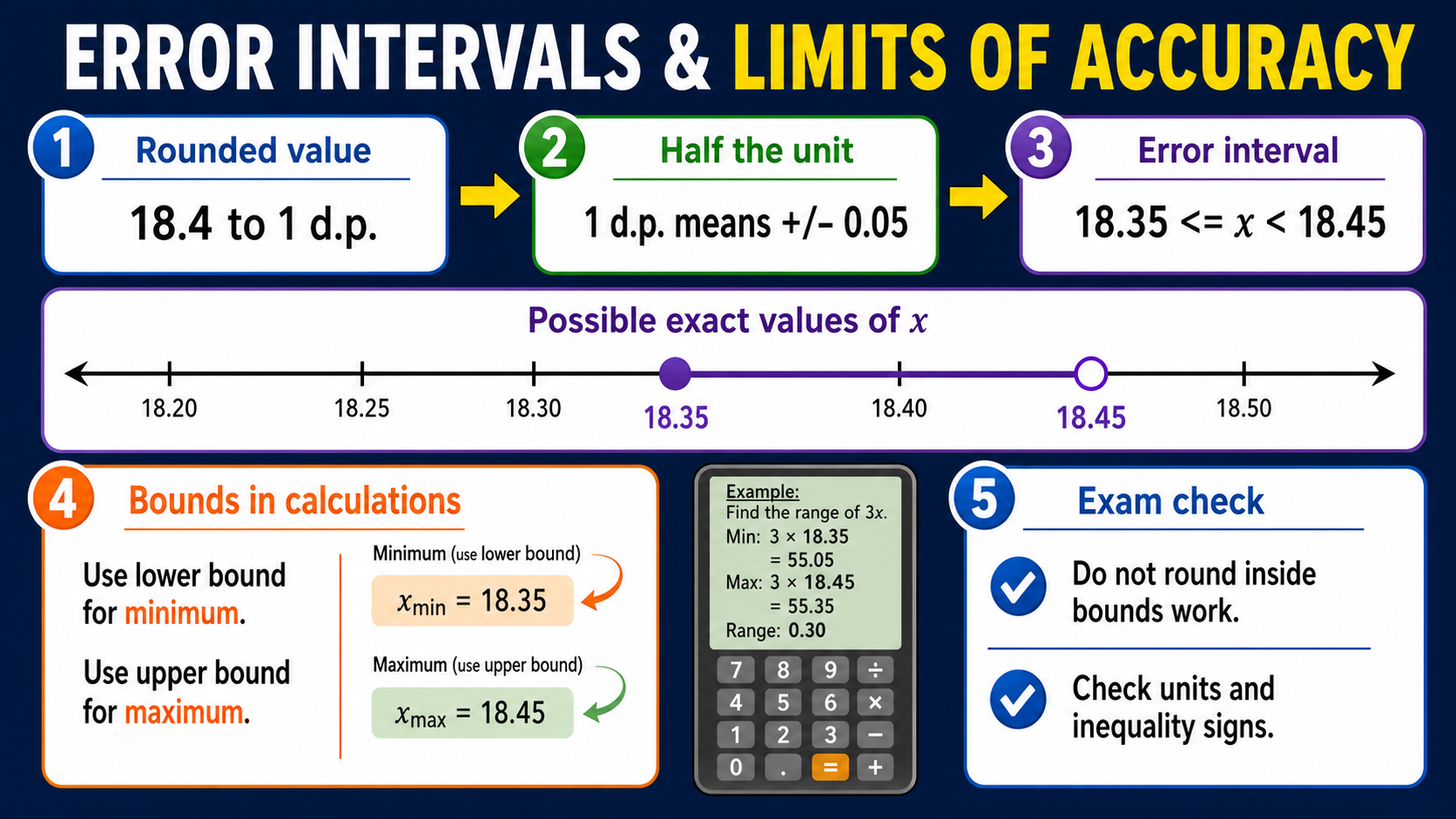
Error intervals and limits of accuracy infographic
Before viewing
Before viewing, identify the rounded value, the rounding unit and the half-unit either side.
After viewing
After viewing, write the error interval for a value rounded to the nearest whole number and explain why the upper end is not included.
Why this matters
Measurements in GCSE questions are often rounded. Bounds show the full range of possible exact values and protect against over-precise answers.
Prior knowledge
You should already be comfortable with:
Clear explanation
Main idea
If a length is 8 cm to the nearest cm, the exact length is at least 7.5 cm but less than 8.5 cm. Write 7.5 ≤ x < 8.5. The lower end is included; the upper end is not, because 8.5 would round to 9 cm.
Method
Find the rounding unit first. Half of that unit gives the amount to subtract and add. For 4.6 cm to the nearest 0.1 cm, half the unit is 0.05 cm, so 4.55 ≤ x < 4.65.
Answer tip
For calculations, choose the bounds that make the requested result largest or smallest. For a fraction, the maximum often uses the largest numerator and smallest denominator; the minimum uses the smallest numerator and largest denominator.
Worked examples
Nearest ten
A number is 340 to the nearest 10.
Reveal answer
Answer: Half of 10 is 5, so 335 ≤ x < 345.
Decimal interval
A length is 4.6 cm to the nearest 0.1 cm.
Reveal answer
Answer: Half of 0.1 is 0.05, so 4.55 ≤ l < 4.65.
Area bounds
A rectangle is 6 cm by 4 cm to the nearest cm. Smallest possible area?
Reveal answer
Answer: Use the smallest possible length and width: 5.5 × 3.5 = 19.25 cm².
Quick checks
Choose an answer, then check your thinking.
1. A length is 28 cm to the nearest cm. Which interval is correct?
2. To maximise a/b when a and b are both rounded, which bounds should you try?
Practice questions
Question 1
A parcel has mass 12 kg to the nearest kg. Write its error interval and explain why the upper endpoint is not included.
Reveal answer and marking guidance
Answer: 11.5 ≤ m < 12.5.
Marking: Half of 1 kg is 0.5 kg. Include 11.5 because it rounds to 12, but exclude 12.5 because it would round up to 13.
Question 2
A measured length is 4.6 cm to the nearest 0.1 cm. Find the lower bound and state the rounding unit you used.
Reveal answer and marking guidance
Answer: 4.55 cm.
Marking: The rounding unit is 0.1 cm, so half of the unit is 0.05 cm. Lower bound = 4.6 − 0.05 = 4.55 cm.
Question 3
A speed camera reading is recorded as 50 mph to the nearest 5 mph. Write the possible interval for the actual speed.
Reveal answer and marking guidance
Answer: 47.5 ≤ s < 52.5.
Marking: Half of 5 mph is 2.5 mph, so subtract and add 2.5. Use < at the upper bound because 52.5 would round to 55 mph.
Question 4
A square side length is 7 cm to the nearest cm. Find the smallest possible area, using the correct bound for the side length.
Reveal answer and marking guidance
Answer: 42.25 cm².
Marking: The smallest possible side length is 6.5 cm, so the smallest possible area is 6.5 × 6.5 = 42.25 cm².
Question 5
A distance is 18.4 km to the nearest 0.1 km. Write the error interval.
Reveal answer and marking guidance
Answer: 18.35 ≤ d < 18.45.
Marking: Half of 0.1 km is 0.05 km; include the lower bound and exclude the upper bound.
Question 6
A rectangle has length 9 cm and width 5 cm, both to the nearest cm. Find the largest possible area.
Reveal answer and marking guidance
Answer: 52.25 cm².
Marking: Use upper bounds 9.5 cm and 5.5 cm, then calculate 9.5 × 5.5 = 52.25.
Question 7
A distance is 40 m to the nearest metre and a time is 8.0 s to the nearest 0.1 s. Find the minimum possible speed.
Reveal answer and marking guidance
Answer: 39.5 ÷ 8.05 = 4.906... m/s, so about 4.91 m/s to 3 significant figures.
Marking: For minimum speed, use the smallest distance and the largest time.
Question 8
A rounded value is 0.072 to 3 decimal places. Write its error interval.
Reveal answer and marking guidance
Answer: 0.0715 ≤ x < 0.0725.
Marking: Three decimal places means the rounding unit is 0.001, so half the unit is 0.0005.
Question 9
A rounded value a is 12.4 to the nearest 0.1, and a rounded value b is 3.0 to the nearest 0.1. Find the maximum possible value of a ÷ b.
Reveal answer and marking guidance
Answer: 12.45 ÷ 2.95 = 249/59 = 4.2203..., so about 4.22 to 3 significant figures.
Marking: For the maximum quotient, use the upper bound for a and the lower bound for b. Keep the calculation unrounded until the final answer.
Question 10
A garden path is 8.2 m long to the nearest 0.1 m and 1.6 m wide to the nearest 0.1 m. Find the minimum possible area.
Reveal answer and marking guidance
Answer: 8.15 × 1.55 = 12.6325 m².
Marking: For the minimum area, use the lower bound of both measurements. Half of 0.1 m is 0.05 m, so the lower bounds are 8.15 m and 1.55 m.
Answers and marking guidance
The exact practice answers are hidden under each question so you can try first. For bounds questions, marks usually come from identifying the rounding unit, halving it correctly, writing a precise interval with ≤ and <, choosing the correct upper or lower bounds for any calculation, and keeping sensible units and accuracy in the final answer.
Common mistakes
- Using a whole unit instead of half: nearest 10 means add and subtract 5, not 10.
- Including the upper endpoint: 8.5 would round to 9, so write x < 8.5 rather than x ≤ 8.5.
- Choosing the wrong extreme: maximum area uses largest length and largest width, but maximum speed uses largest distance and smallest time.
- Rounding inside the bounds calculation: keep extra accuracy until the final requested answer.
Extension challenge
A distance is 120 m to the nearest 10 m and a time is 9.0 s to the nearest 0.1 s. Find the maximum possible speed in m/s, then explain which bounds you used.
Reveal answer
Example answer: Distance has upper bound 125 m and time has lower bound 8.95 s, so maximum speed is 125 ÷ 8.95 = 13.966... m/s, about 14.0 m/s to 3 significant figures. Use largest distance and smallest time because speed = distance ÷ time.
Exam-board guidance
Error Intervals and Limits of Accuracy appears within GCSE Maths number and measures content. Exact wording, tiering and calculator expectations can vary, but the core skill is the same: identify the rounding unit, form precise bounds, then choose the bounds that answer the question.
AQA GCSE Maths
Focus on the shared method, notation and checking habit; wording and context can vary by route.
OCR GCSE Maths
Show clear method steps and use precise notation; question wording may vary by route.
Pearson Edexcel GCSE Maths
Keep working visible and check units or notation; contexts may vary by route.
Eduqas GCSE Maths
Use the same core skill in practical contexts, with clear reasoning and final checks.
WJEC Wales
Connect the method to the context and state what the result means.
CCEA GCSE Maths
Make each method step visible and keep notation, units and final checks clear.
Next lesson
Next, continue with Percentages: Finding and Comparing.