
Lesson overview
Four Operations and Calculator Checks is part of GCSE Maths Number.
Choose efficient methods for addition, subtraction, multiplication and division, then check answers sensibly. Questions may involve decimals, money, measures, remainders, estimates, inverse operations or multi-step contexts.
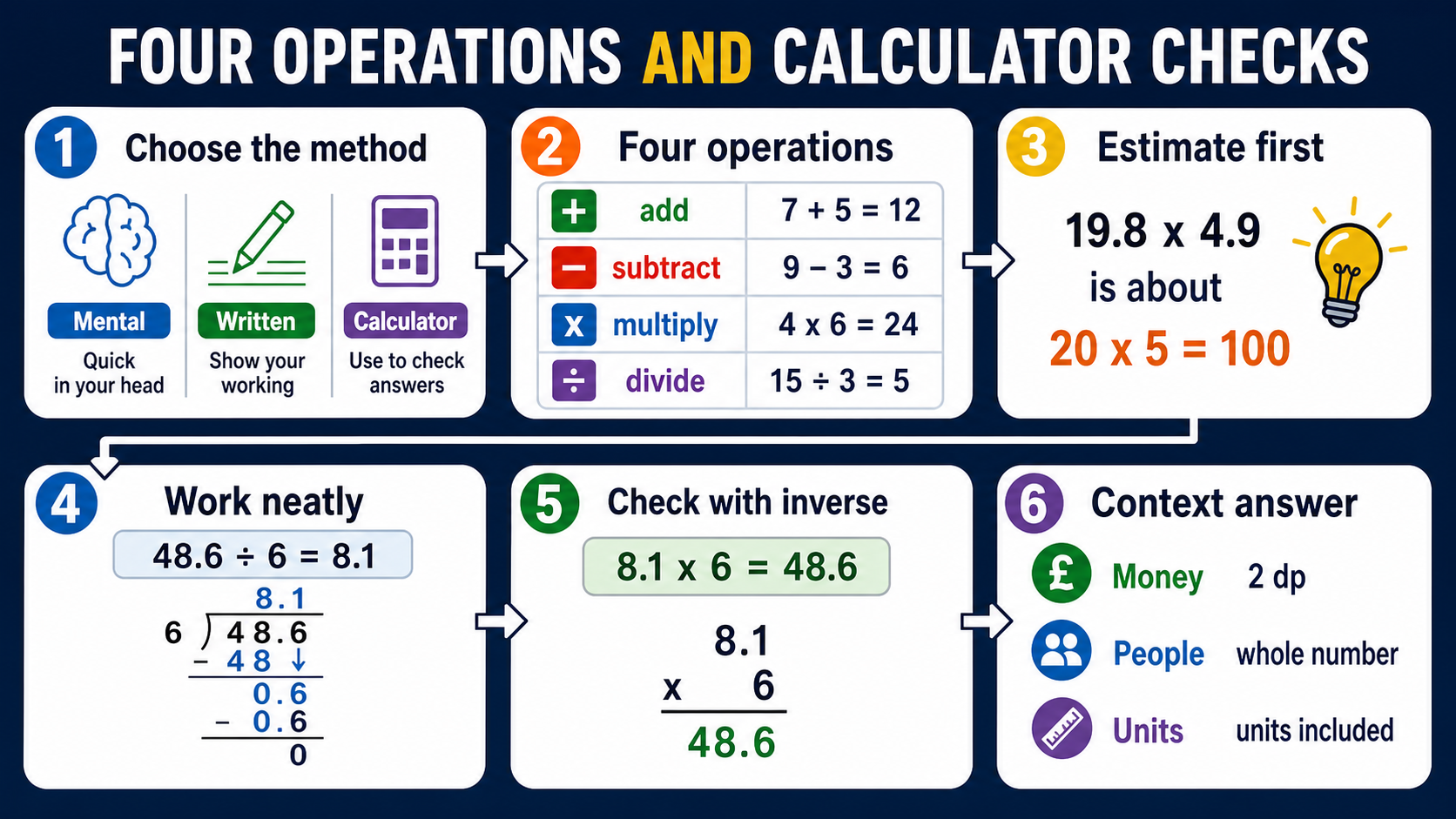
Four operations and calculator checks infographic
Before viewing
Before viewing, identify where each of the four operations appears and say what calculation clue points to it.
After viewing
After viewing, estimate one calculation before using the exact method, then explain whether the answer is sensible.
What you will learn
Key facts before you start
Why this matters
GCSE questions often hide simple arithmetic inside ratio, algebra, geometry and statistics. Reliable checks stop method marks being lost at the final step.
Prior knowledge
You should already be comfortable with:
Clear explanation
Main idea
Addition combines quantities; subtraction finds a difference or what remains. Keep decimal points lined up when using written methods.
Method
Multiplication can be treated as repeated scaling. Division can mean sharing equally or finding how many groups fit. In multi-step work, write the operation order down before using a calculator so brackets go in the right place.
Answer tip
A calculator answer still needs judgement. Estimate first, use brackets when needed, and decide whether a remainder should be rounded, left as a decimal, written to two decimal places, or interpreted in words.
Worked examples
Calculator check
Estimate 48.9 × 21.3.
Reveal answer
Answer: 50 × 20 = 1000, so a calculator answer near 1041 is sensible.
Remainder context
125 pupils travel in minibuses holding 16 pupils each.
Reveal answer
Answer: 125 ÷ 16 = 7 remainder 13, so 8 minibuses are needed.
Calculator brackets
Calculate (36.4 − 18.8) × 5 and give an estimate.
Reveal answer
Answer: 36.4 − 18.8 = 17.6, then 17.6 × 5 = 88. An estimate is (36 − 18) × 5 = 90, so 88 is sensible.
Quick checks
Choose an answer, then check your thinking.
1. A calculator gives 4.86 × 19.7 = 95.742. Which estimate best checks it?
2. 58 pupils need taxis that seat 6 pupils each. How many taxis are needed?
Practice questions
Question 1
A science practical uses 3.6 ml of one solution and 14.75 ml of another. Calculate the total volume, showing how you line up the decimals.
Reveal answer and marking guidance
Answer: 18.35 ml.
Marking: Write 3.60 + 14.75 so the decimal points and place-value columns line up, then include the unit.
Question 2
A printer makes 48 booklets with 25 pages in each booklet. Calculate the total number of pages, using a mental or written method that you can check.
Reveal answer and marking guidance
Answer: 1200 pages.
Marking: A clear method is 48 × 100 ÷ 4 = 1200, or 50 × 25 − 2 × 25 = 1200. Include the context unit.
Question 3
A £96 bill is shared equally by 8 people. How much should each person pay, and why does the answer need money notation?
Reveal answer and marking guidance
Answer: £12.00 each.
Marking: 96 ÷ 8 = 12. In a money context, £12.00 or £12 is acceptable, but two decimal places are often clearer.
Question 4
A calculator display for 19.8 × 31.2 is checked before it is copied into an answer. Give a sensible estimate and explain what it tells you.
Reveal answer and marking guidance
Answer: About 600.
Marking: Round to 20 × 30 = 600. A calculator answer near 618 is sensible; an answer near 60 or 6000 would suggest a keying or place-value error.
Question 5
Calculate 7.2 − 3.85.
Reveal answer and marking guidance
Answer: 3.35.
Marking: Write 7.20 − 3.85 so the hundredths, tenths and ones columns line up.
Question 6
18 boxes each hold 24 pencils. How many pencils are there altogether?
Reveal answer and marking guidance
Answer: 432 pencils.
Marking: 18 × 24 = 432; include the unit in the final answer.
Question 7
125 stickers are packed into sheets of 12. How many full sheets can be made, and how many stickers are left over?
Reveal answer and marking guidance
Answer: 10 full sheets with 5 stickers left over.
Marking: 125 ÷ 12 = 10 remainder 5; do not round up because the question asks for full sheets.
Question 8
Use a calculator to find (46.8 − 19.5) ÷ 3, then give a quick estimate to check it.
Reveal answer and marking guidance
Answer: 9.1.
Marking: 46.8 − 19.5 = 27.3, and 27.3 ÷ 3 = 9.1. An estimate such as (47 − 20) ÷ 3 = 9 checks the size.
Question 9
A school buys 14 packs of pens at £3.75 each and pays with £60. How much change should it receive?
Reveal answer and marking guidance
Answer: £7.50.
Marking: 14 × £3.75 = £52.50, then £60 − £52.50 = £7.50. Keep money answers to two decimal places.
Question 10
A coach company charges £185 plus £12.50 per pupil. A trip has 34 pupils and the total cost is shared equally. What is the cost per pupil?
Reveal answer and marking guidance
Answer: £17.94 per pupil to the nearest penny.
Marking: Calculate 185 + 34 × 12.50 = 610, then 610 ÷ 34 = 17.941... . Because it is money, round to two decimal places.
Answers and marking guidance
The exact practice answers are hidden under each question so you can try first. For four-operations questions, marks usually come from choosing the right operation, setting out decimal points and place value clearly, using brackets correctly on a calculator, carrying units through working, and interpreting the final answer in context. Estimates and inverse checks are useful evidence that your answer is sensible.
Common mistakes
- Ignoring place value in decimals: keep decimal points lined up for addition and subtraction.
- Rounding the final context wrongly: buses, boxes or taxis often need rounding up, while money may need two decimal places.
- Trusting a calculator entry blindly: use brackets and an estimate to catch keying errors.
- Using the inverse check backwards: if you divided, multiply your answer by the divisor to see whether you return to the starting value.
Extension challenge
Write a two-step money or travel problem where the exact calculator display is not the final answer. Solve it, then explain whether the final result should be rounded, written to two decimal places or interpreted as a whole number.
Reveal answer
Example answer: A strong response identifies each operation, shows a sensible estimate, uses the calculator accurately and explains the final rounding decision from the context.
Exam-board guidance
Four Operations and Calculator Checks appears throughout GCSE Maths. The shared skill is not just calculating accurately, but choosing a method, checking the size of the result and interpreting the answer in context.
AQA GCSE Maths
Focus on the shared method, notation and checking habit; wording and context can vary by route.
OCR GCSE Maths
Show clear method steps and use precise notation; question wording may vary by route.
Pearson Edexcel GCSE Maths
Keep working visible and check units or notation; contexts may vary by route.
Eduqas GCSE Maths
Use the same core skill in practical contexts, with clear reasoning and final checks.
WJEC Wales
Connect the method to the context and state what the result means.
CCEA GCSE Maths
Make each method step visible and keep notation, units and final checks clear.
Next lesson
Next, continue with Factors, Multiples and Divisibility.