
Lesson overview
Place Value, Ordering and Comparing Numbers is part of GCSE Maths Number.
Read, order and compare integers, decimals and large numbers using place value. Questions may ask you to compare values in different forms, explain inequality statements, use number lines or decide whether a rounded value is sensible.
What you will learn
Key facts before you start
Why this matters
Place value is the base layer for rounding, estimation, standard form, percentages, ratio and calculator checks.
Prior knowledge
You should already be comfortable with:
Place value, ordering and comparing infographic
Before viewing
Before viewing, point to the digit with the greatest value and explain why its column matters.
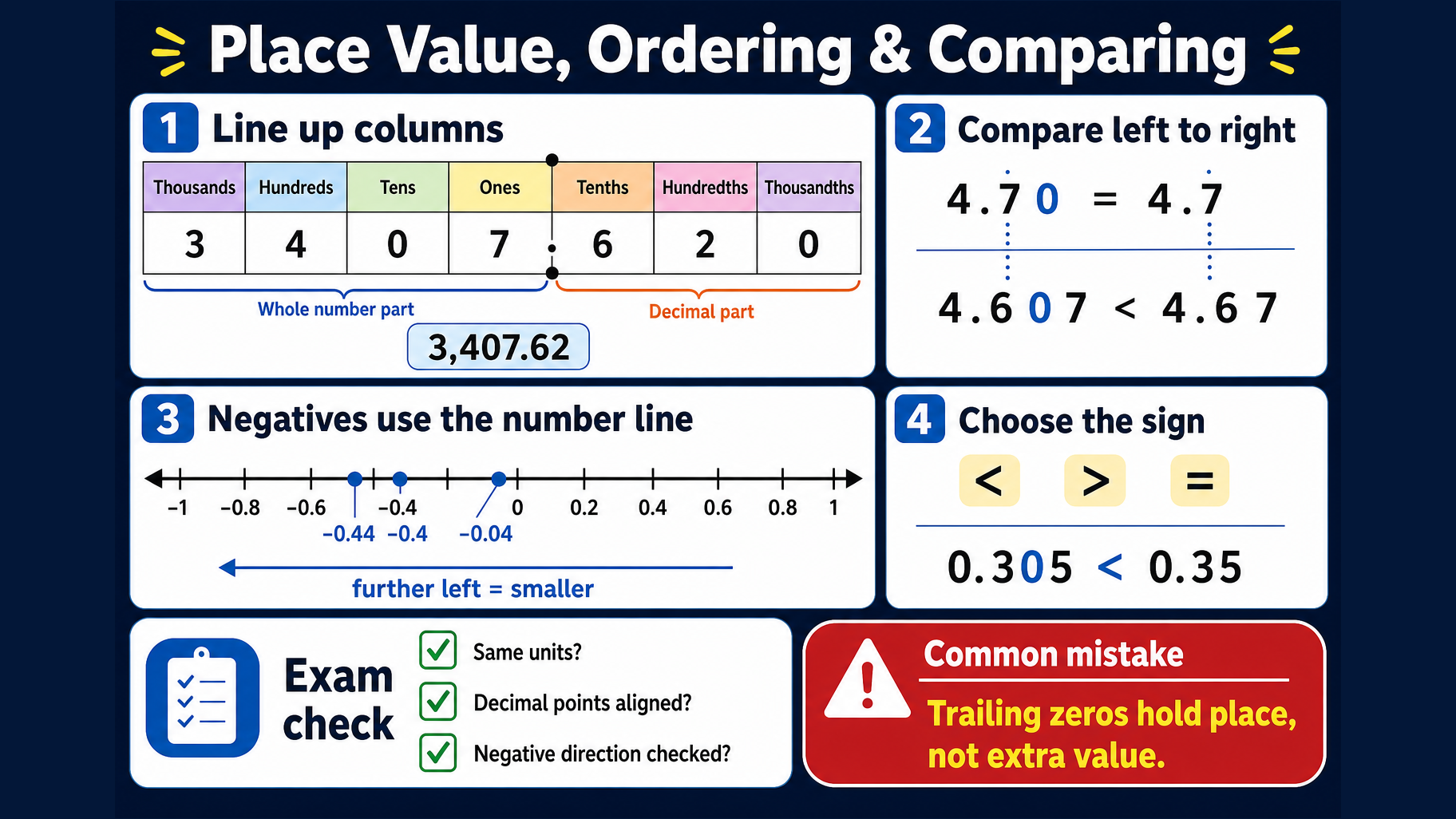
After viewing
After viewing, order four numbers and state the first column where they differ.
Clear explanation
Main idea
Every digit has a value because of its position. In 4,307.52 the 3 means 300, the 7 means 7 ones, the 5 means 5 tenths and the 2 means 2 hundredths.
Method
To compare decimals, line up the decimal points and compare from left to right. Add placeholder zeros only to help reading; 0.7 and 0.70 are equal. If units differ, convert first, for example 1.2 m = 120 cm before comparing with 95 cm.
Answer tip
On a number line, numbers further right are larger. With negatives, -2 is greater than -5 because it is closer to zero. Rounded values can hide exact size, so read the question carefully before deciding whether two measurements are definitely equal.
Worked examples
Ordering decimals
Put 0.45, 0.5, 0.405 and 0.54 in ascending order.
Reveal answer
Answer: Write as 0.450, 0.500, 0.405, 0.540, so the order is 0.405, 0.45, 0.5, 0.54.
Comparing negatives
Which is larger: -3.2 or -3.02?
Reveal answer
Answer: -3.02 is larger because it is closer to zero.
Comparing with units
Which is longer: 0.84 m or 79 cm?
Reveal answer
Answer: Convert first: 0.84 m = 84 cm, and 84 cm > 79 cm, so 0.84 m is longer.
Quick checks
Choose an answer, then check your thinking.
1. Which number is the smallest?
2. Which decimal place-value statement is true?
Practice questions
Question 1
A school prints 52,781 revision booklets. Write the value of the digit 7 in this number and name its place-value column.
Reveal answer and marking guidance
Answer: 700; the 7 is in the hundreds column.
Marking: Identify the hundreds column and give the digit value as 7 hundreds, not just the digit 7.
Question 2
Three athletes jump 0.63 m, 0.603 m and 0.36 m in a standing jump drill. Put the distances in ascending order.
Reveal answer and marking guidance
Answer: 0.36 m, 0.603 m, 0.63 m.
Marking: Line up decimals as 0.360, 0.603 and 0.630, then compare digit by digit and keep the units.
Question 3
At 6 am, one town is at −4°C and another is at −7°C. Which temperature is greater, and how would you justify it on a number line?
Reveal answer and marking guidance
Answer: −4°C is greater.
Marking: −4 is further right on the number line than −7, so it represents the warmer temperature.
Question 4
A video has 3.5 million views. Write this number in digits and explain the role of the zero placeholders.
Reveal answer and marking guidance
Answer: 3,500,000.
Marking: 3.5 million is 3 million plus 0.5 million, so the zeros hold the thousands, hundreds, tens and ones places.
Question 5
Put -1.08, -1.8, -0.18 and 0.018 in ascending order.
Reveal answer and marking guidance
Answer: -1.8, -1.08, -0.18, 0.018.
Marking: Use a number line: the most negative value is smallest, then compare the decimal places.
Question 6
Two screws are measured as 0.407 cm and 0.47 cm wide. Fill in the correct symbol: 0.407 ___ 0.47.
Reveal answer and marking guidance
Answer: 0.407 < 0.47.
Marking: Compare as 0.407 and 0.470; the tenths match but 0 hundredths is less than 7 hundredths.
Question 7
A desk is 1.2 m long and a shelf is 95 cm long. Which is larger?
Reveal answer and marking guidance
Answer: The 1.2 m desk is larger.
Marking: Convert first: 1.2 m = 120 cm, and 120 cm > 95 cm.
Question 8
A number rounded to one decimal place is 4.6. Could the original number have been 4.54?
Reveal answer and marking guidance
Answer: No.
Marking: 4.54 rounds to 4.5 to one decimal place; values from 4.55 up to 4.649... round to 4.6.
Question 9
Write the largest of these values: 0.609, 0.69, 0.6901 and 0.6099.
Reveal answer and marking guidance
Answer: 0.6901.
Marking: Compare as 0.6090, 0.6900, 0.6901 and 0.6099; 0.6901 is just larger than 0.6900.
Question 10
Order these race times from fastest to slowest: 12.405 s, 12.45 s, 12.4501 s and 12.399 s.
Reveal answer and marking guidance
Answer: 12.399 s, 12.405 s, 12.45 s, 12.4501 s.
Marking: Fastest means the smallest time. Compare as 12.3990, 12.4050, 12.4500 and 12.4501; trailing zeros help line up the decimal places but do not change the value.
Answers and marking guidance
The exact practice answers are hidden under each question so you can try first. For place-value questions, marks usually come from identifying the correct column value, lining up decimal points, ordering values from left to right on a number line, converting units before comparing and using inequality symbols the correct way round. In explanation questions, say which digit, position, unit conversion or rounding boundary decides the comparison.
Common mistakes
- Treating longer decimals as larger: 0.603 is less than 0.63 because 0.603 = 0.603 and 0.63 = 0.630.
- Forgetting how negatives order: -7 is smaller than -4 because it is further left on the number line.
- Changing value with placeholder zeros: 0.7 and 0.70 are equal; zeros can help comparison but do not change the number.
- Reading the wrong digit column: separate thousands, hundreds, tens, ones, tenths and hundredths before naming a digit value.
Extension challenge
Create five values using the digits 0, 3, 5 and 7, including one negative decimal and one number greater than one thousand. Put them in ascending order and explain the two comparisons that were easiest to get wrong.
Reveal answer
Example answer: A strong response lines up decimal points, handles the negative value using a number line and gives a clear reason for each inequality symbol.
Exam-board guidance
Place Value, Ordering and Comparing Numbers appears across GCSE Maths number work. The shared skill is to read the size of each number accurately before calculating, rounding or interpreting a context.
AQA GCSE Maths
Focus on the shared method, notation and checking habit; wording and context can vary by route.
OCR GCSE Maths
Show clear method steps and use precise notation; question wording may vary by route.
Pearson Edexcel GCSE Maths
Keep working visible and check units or notation; contexts may vary by route.
Eduqas GCSE Maths
Use the same core skill in practical contexts, with clear reasoning and final checks.
WJEC Wales
Connect the method to the context and state what the result means.
CCEA GCSE Maths
Make each method step visible and keep notation, units and final checks clear.
Next lesson
Next, continue with Factors, Multiples and Divisibility.