
Lesson overview
Listing Outcomes and Sample Space Diagrams is part of GCSE Maths Probability.
Listing outcomes and sample space diagrams are tested across GCSE probability. The key skill is organising every possible outcome so the denominator is correct before you write a probability.
What you will learn
Key facts before you start
Listing outcomes and sample space diagrams infographic
Before viewing
Before viewing, check whether every possible outcome has been listed once.
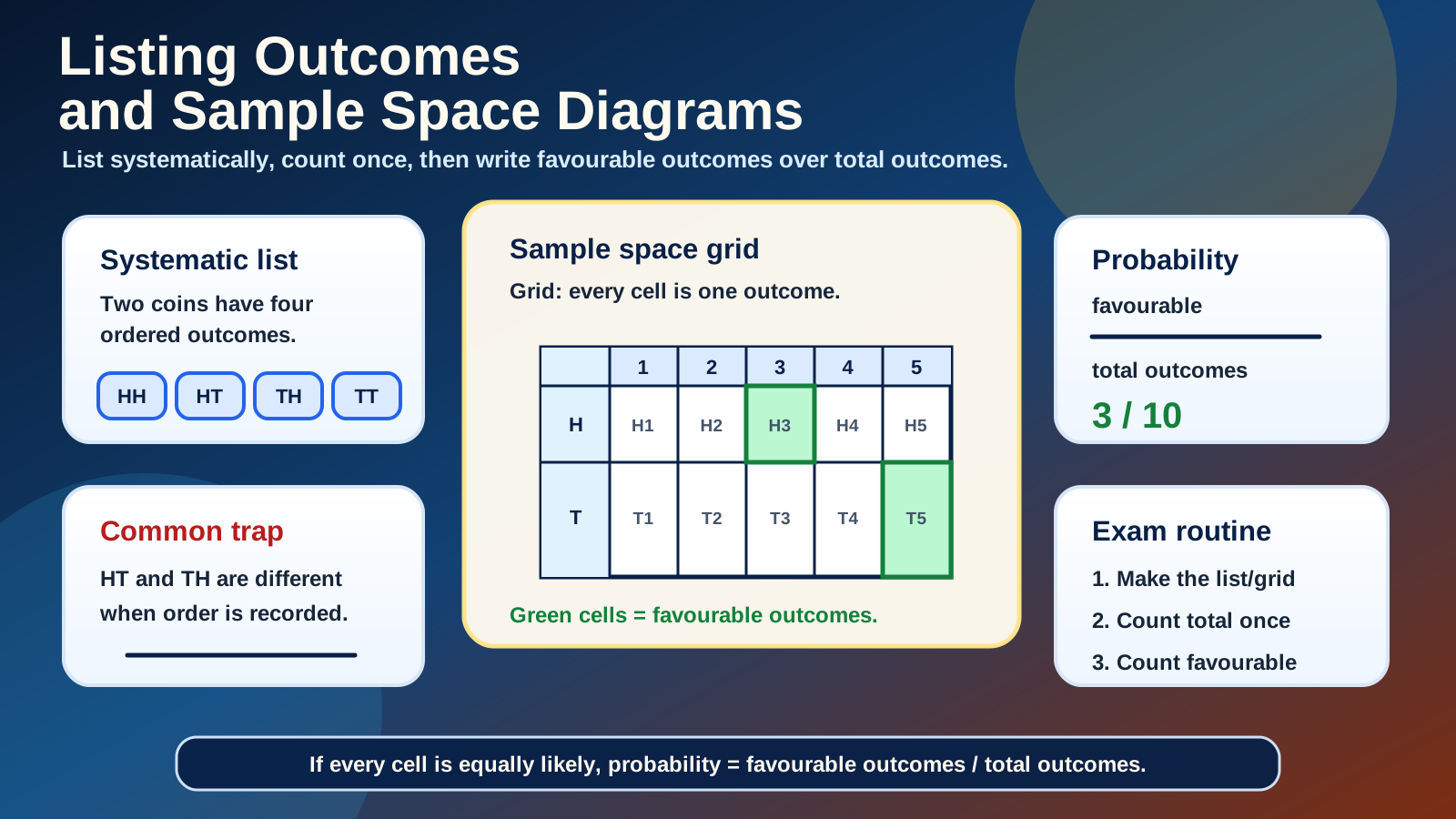
After viewing
After viewing, build a sample space and count favourable outcomes.
Why this matters
A neat sample space turns messy worded probability into visible counting.
Prior knowledge
You should already be comfortable with:
Clear explanation
Main idea
A sample space is the complete set of possible outcomes. For two coins, HH, HT, TH and TT are four equally likely outcomes because HT and TH are different orders.
Method
Use a table when two choices combine. Put one choice across the top, the other down the side, then fill every cell once. The total number of cells is the denominator only when all outcomes are equally likely.
If an outcome can happen in more than one way, do not collapse the list too early. For example, a total of 3 from two dice can be 1 then 2 or 2 then 1, so those are two ordered outcomes.
Answer tip
Write the event you are counting before the fraction. That stops you using the number of favourable outcomes as both numerator and denominator.
Worked examples
Two coins
Find the probability of exactly one head.
Reveal answer
Answer: Outcomes HH, HT, TH, TT. Exactly one head: HT and TH, so 2/4 = 1/2.
Fair game check
A coin is tossed and a fair spinner numbered 1 to 4 is spun. You win if the coin is tails and the spinner lands on an even number. Is the chance 1/2?
Reveal answer
Answer: No. The favourable outcomes are T2 and T4, so the probability is 2/8 = 1/4.
Ordered dice totals
Two fair dice are rolled. How many ordered outcomes give a total of 4?
Reveal answer
Answer: Three outcomes: (1,3), (2,2) and (3,1). The order matters because the first and second dice are separate.
Quick checks
Choose an answer, then check your thinking.
1. Two coins are tossed. Which list is complete?
2. In a 3 by 4 sample space with equally likely cells, what is the denominator?
Practice questions
Question 1
A fair dice is rolled and a fair coin is tossed. How many ordered outcomes are in the complete sample space, and what multiplication checks this?
Reveal answer and marking guidance
Answer: 12 outcomes.
Marking: There are 6 dice outcomes and 2 coin outcomes, so 6 × 2 = 12. A table with dice results down one side and coin results across the top would have 12 cells.
Question 2
Two coins are tossed in order. List the sample space and find the probability of two tails.
Reveal answer and marking guidance
Answer: 1/4.
Marking: The complete ordered sample space is HH, HT, TH, TT. Only TT is successful, so the probability is 1 out of 4.
Question 3
A fair spinner has 5 equal sections numbered 1 to 5. A fair coin is tossed. Find P(heads and an odd number).
Reveal answer and marking guidance
Answer: 3/10.
Marking: There are 2 × 5 = 10 equally likely outcomes. Heads with 1, 3 or 5 gives 3 favourable outcomes.
Question 4
A cafe offers 3 sandwich fillings and 2 breads. One filling and one bread are chosen for a lunch order. Why is a table useful?
Reveal answer and marking guidance
Answer: It shows all 6 combinations once, so none are missed or counted twice.
Marking: Mention both the total combinations and the systematic organisation.
Question 5
A fair red-blue spinner is spun twice. List the sample space and find the probability of getting one red and one blue.
Reveal answer and marking guidance
Answer: RR, RB, BR, BB; probability = 2/4 = 1/2.
Marking: RB and BR are different ordered outcomes, and both have one red and one blue.
Question 6
A meal deal has 2 mains, 3 drinks and 2 snacks. How many complete meal deals are possible?
Reveal answer and marking guidance
Answer: 12.
Marking: Multiply the choices: 2 × 3 × 2 = 12 possible meal deals.
Question 7
A fair 1 to 6 dice is rolled twice. How many ordered outcomes give a total of 7?
Reveal answer and marking guidance
Answer: 6 outcomes: (1,6), (2,5), (3,4), (4,3), (5,2), (6,1).
Marking: Treat the first and second roll as ordered, so (1,6) and (6,1) are different outcomes.
Question 8
A bag contains cards A, B and C. Two cards are chosen in order with replacement. List the sample space and find P(two different letters).
Reveal answer and marking guidance
Answer: AA, AB, AC, BA, BB, BC, CA, CB, CC; P(two different letters) = 6/9 = 2/3.
Marking: Replacement keeps 3 choices on each draw. Count the 6 ordered pairs with different letters out of 9 equally likely outcomes.
Question 9
Two fair dice are rolled. Find the probability that the total is less than 5.
Reveal answer and marking guidance
Answer: 1/6.
Marking: Totals less than 5 are 2, 3 and 4. The ordered outcomes are (1,1), (1,2), (2,1), (1,3), (2,2) and (3,1), so 6/36 = 1/6.
Question 10
A fair spinner has equal sections numbered 1, 2 and 3. A fair coin is tossed. A player wins if the spinner lands on 2 or the coin lands on heads. Use a sample space to decide whether the game is fair.
Reveal answer and marking guidance
Answer: Not fair; P(win) = 4/6 = 2/3.
Marking: The six outcomes are 1H, 1T, 2H, 2T, 3H and 3T. Winning outcomes are 1H, 2H, 2T and 3H. Do not count 2H twice just because it satisfies both winning conditions.
Answers and marking guidance
The exact practice answers are hidden under each question so you can try first. For listing outcomes and sample space diagrams, marks usually come from showing a complete organised list or table, using the correct total number of equally likely outcomes, counting the favourable outcomes once each, and simplifying the final probability when appropriate.
Common mistakes
- Missing ordered outcomes: HT and TH are different when the first and second toss are named in order.
- Assuming every list is equally likely: only use count ÷ total when each outcome has the same chance.
- Double-counting combinations: use a table or pattern so each possible result appears once.
- Using the favourable count as the denominator: the denominator is the total number of equally likely outcomes.
Extension challenge
Make a sample space diagram for rolling a 1-4 spinner and a 1-6 dice, then find the probability that the total is 7 or more.
Reveal answer
Example answer: There are 24 equally likely outcomes. Totals of 7 or more occur 10 times, so the probability is 10/24 = 5/12.
Exam-board guidance
Listing Outcomes and Sample Space Diagrams appears within the shared GCSE Maths probability content. Exact tiering and wording vary, but every board rewards complete organisation, clear event labels and a check that the outcomes are equally likely before probability calculation.
AQA GCSE Maths
Focus on the shared method, notation and checking habit; wording and context can vary by route.
OCR GCSE Maths
Show clear method steps and use precise notation; question wording may vary by route.
Pearson Edexcel GCSE Maths
Keep working visible and check units or notation; contexts may vary by route.
Eduqas GCSE Maths
Use the same core skill in practical contexts, with clear reasoning and final checks.
WJEC Wales
Connect the method to the context and state what the result means.
CCEA GCSE Maths
Make each method step visible and keep notation, units and final checks clear.
Next lesson
Next, continue with Frequency Trees and Two-Way Tables.