
Lesson overview
Recurring Decimals and Fractions is part of GCSE Maths Number.
Convert recurring decimals to fractions using simple algebra. Start by learning to recognise recurring notation and common fraction-decimal links. Then learn how to be ready to line up one-digit, two-digit and delayed repeats, subtract, then simplify the exact fraction.
What you will learn
Key facts before you start
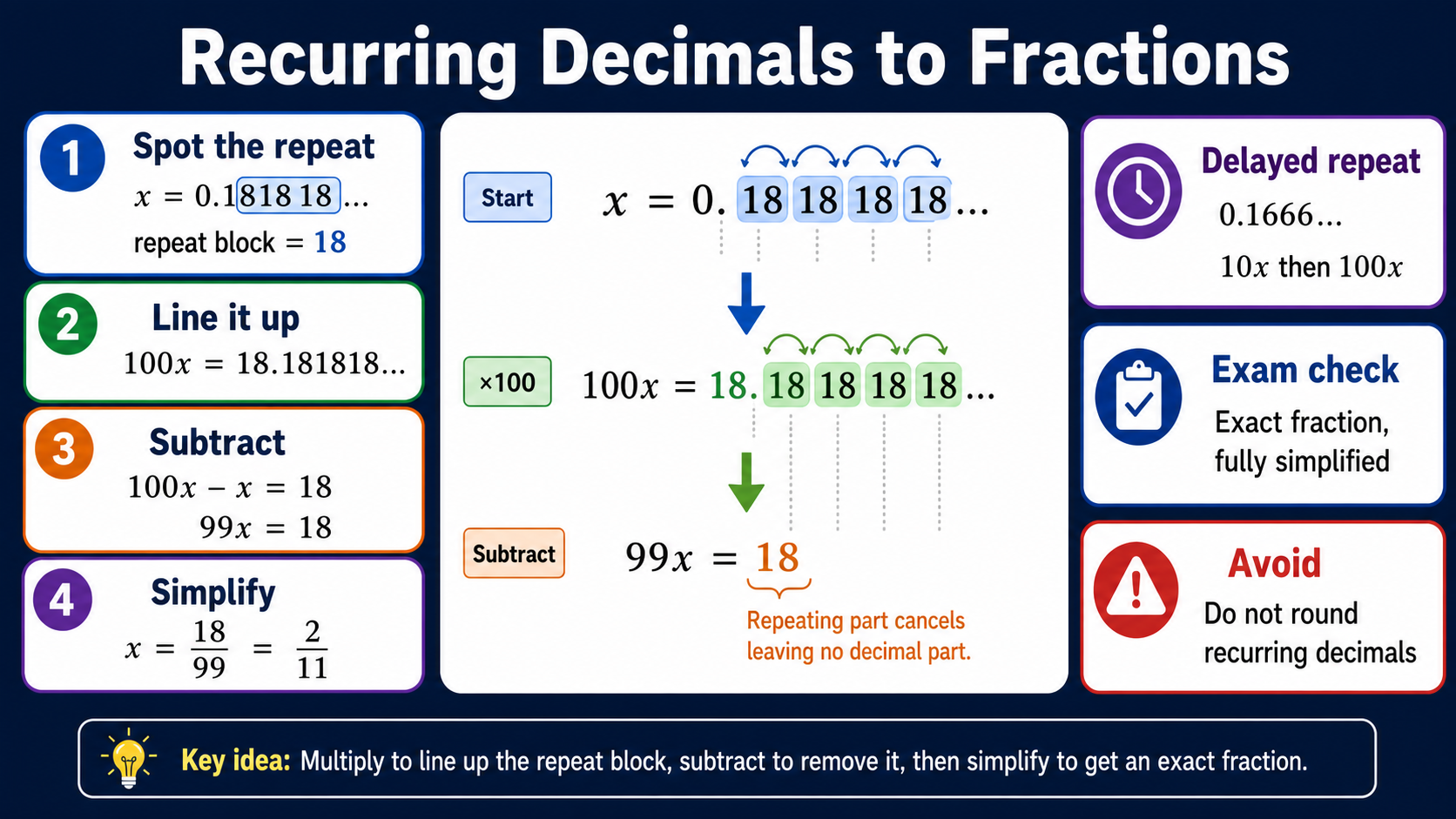
Recurring decimals to fractions infographic
Before viewing
Before viewing, identify the repeating digit or block before starting any algebra.
After viewing
After viewing, convert a simple recurring decimal to a fraction and explain how subtraction removed the recurring part.
Why this matters
Recurring decimals link number, fractions and algebra. Exact fraction form is often cleaner than a rounded calculator display.
Prior knowledge
You should already be comfortable with:
Clear explanation
Main idea
A recurring decimal has a digit or block of digits that repeats forever. For example, 0.333... = 1/3, while 0.3 is a terminating decimal and 0.33 is just two decimal places.
Method
To convert a recurring decimal to a fraction, call it x, multiply by 10, 100 or 1000 so the recurring block lines up, then subtract the original equation. The repeating tails cancel, leaving a simple equation.
Answer tip
For 0.272727..., let x = 0.272727... Then 100x = 27.272727..., so 99x = 27 and x = 27/99 = 3/11. If the repeat is delayed, such as 0.1666..., use 10x and 100x so the recurring 6s line up before subtracting.
Worked examples
Single recurring digit
Convert 0.777... to a fraction.
Reveal answer
Answer: Let x = 0.777... Then 10x = 7.777..., so 9x = 7 and x = 7/9.
Two recurring digits
Convert 0.454545... to a fraction.
Reveal answer
Answer: Let x = 0.454545... Then 100x = 45.454545... Subtracting gives 99x = 45, so x = 45/99 = 5/11.
Delayed recurring digit
Convert 0.1666... to a fraction.
Reveal answer
Answer: Let x = 0.1666... Then 10x = 1.666... and 100x = 16.666... Subtracting gives 90x = 15, so x = 15/90 = 1/6.
Quick checks
Choose an answer, then check your thinking.
1. Which equation lines up the repeat in 0.232323...?
2. What is 0.181818... as a fraction?
Practice questions
Question 1
Convert 0.666... to a fraction by setting x equal to the recurring decimal and subtracting equations.
Reveal answer and marking guidance
Answer: 2/3.
Marking: Let x = 0.666..., so 10x = 6.666... and 10x − x = 6. This gives 9x = 6, so x = 6/9 = 2/3.
Question 2
Convert 0.121212... to a fraction in its simplest form. The repeating block is 12.
Reveal answer and marking guidance
Answer: 4/33.
Marking: Let x = 0.121212... Then 100x = 12.121212..., so 99x = 12 and x = 12/99 = 4/33.
Question 3
Write 1/6 as a decimal and make clear which digit recurs.
Reveal answer and marking guidance
Answer: 0.1666...
Marking: 1 ÷ 6 = 0.1666..., with the 6 recurring after the first decimal place. This is exact recurring notation, not rounding.
Question 4
Convert 0.090909... to a fraction and simplify your answer fully.
Reveal answer and marking guidance
Answer: 1/11.
Marking: The repeating block is 09, so 100x = 9.090909... and 99x = 9. Therefore x = 9/99 = 1/11.
Question 5
Convert 0.272727... to a fraction in its simplest form.
Reveal answer and marking guidance
Answer: 3/11.
Marking: 99x = 27, so x = 27/99 = 3/11.
Question 6
Convert 0.1555... to a fraction in its simplest form.
Reveal answer and marking guidance
Answer: 7/45.
Marking: 10x = 1.555... and 100x = 15.555..., so 90x = 14 and x = 14/90 = 7/45.
Question 7
Convert 0.3060606... to a fraction in its simplest form, where the 06 repeats after the first decimal digit.
Reveal answer and marking guidance
Answer: 101/330.
Marking: 10x = 3.060606... and 1000x = 306.060606..., so 990x = 303 and x = 303/990 = 101/330.
Question 8
Write 5/12 as a decimal and state clearly whether it terminates or recurs.
Reveal answer and marking guidance
Answer: 0.41666..., so it recurs.
Marking: The 6 repeats after the first two decimal places; it is not a rounded answer.
Question 9
Convert 0.0727272... to a fraction in its simplest form, where the 72 repeats after the first decimal digit.
Reveal answer and marking guidance
Answer: 4/55.
Marking: Let x = 0.0727272... Then 10x = 0.727272... and 1000x = 72.727272..., so 990x = 72 and x = 72/990 = 4/55.
Question 10
Convert 0.4181818... to a fraction in its simplest form, where the 18 repeats after the first decimal digit.
Reveal answer and marking guidance
Answer: 23/55.
Marking: Let x = 0.4181818... Then 10x = 4.181818... and 1000x = 418.181818..., so 990x = 414 and x = 414/990 = 23/55.
Answers and marking guidance
The exact practice answers are hidden under each question so you can try first. For recurring decimals, marks usually come from defining x, choosing the correct power of 10, subtracting equations so the repeating part cancels, solving the equation and simplifying the final fraction fully. Use recurring-dot or ellipsis notation clearly so your answer is exact, not rounded.
Common mistakes
- Treating a recurring decimal as rounded: 0.333... is exactly 1/3, but 0.33 is not.
- Multiplying by the wrong power of 10: a two-digit repeat such as 45 needs 100x, not 10x.
- Forgetting delayed repeats: for 0.1666..., subtract 10x from 100x so the recurring 6s line up.
- Not simplifying the fraction: 27/99 earns method marks, but 3/11 is the fully simplified answer.
Extension challenge
Convert 0.583333... to a fraction. Then explain why multiplying by 10 and 100 is more useful than multiplying by 1000.
Reveal answer
Example answer: Let x = 0.583333... Then 10x = 5.8333... and 100x = 58.3333..., so 90x = 52.5 and x = 52.5/90 = 525/900 = 7/12. The 3s line up after multiplying by 10 and 100, so 1000 is unnecessary.
Exam-board guidance
Recurring Decimals and Fractions appears within GCSE Maths number content. Exact wording, tiering and calculator expectations can vary, but the core skill is the same: decide whether a decimal is terminating, recurring or rounded, then use exact notation and simplified fraction form.
AQA GCSE Maths
Focus on the shared method, notation and checking habit; wording and context can vary by route.
OCR GCSE Maths
Show clear method steps and use precise notation; question wording may vary by route.
Pearson Edexcel GCSE Maths
Keep working visible and check units or notation; contexts may vary by route.
Eduqas GCSE Maths
Use the same core skill in practical contexts, with clear reasoning and final checks.
WJEC Wales
Connect the method to the context and state what the result means.
CCEA GCSE Maths
Make each method step visible and keep notation, units and final checks clear.
Next lesson
Next, continue with Error Intervals and Limits of Accuracy.