
Lesson overview
Surds and Exact Values is part of GCSE Maths Number.
Simplify surds, use exact forms and avoid rounding too early. extension questions may ask for simplified surd form, operations with like surds, rationalising simple denominators or exact answers involving roots and π.
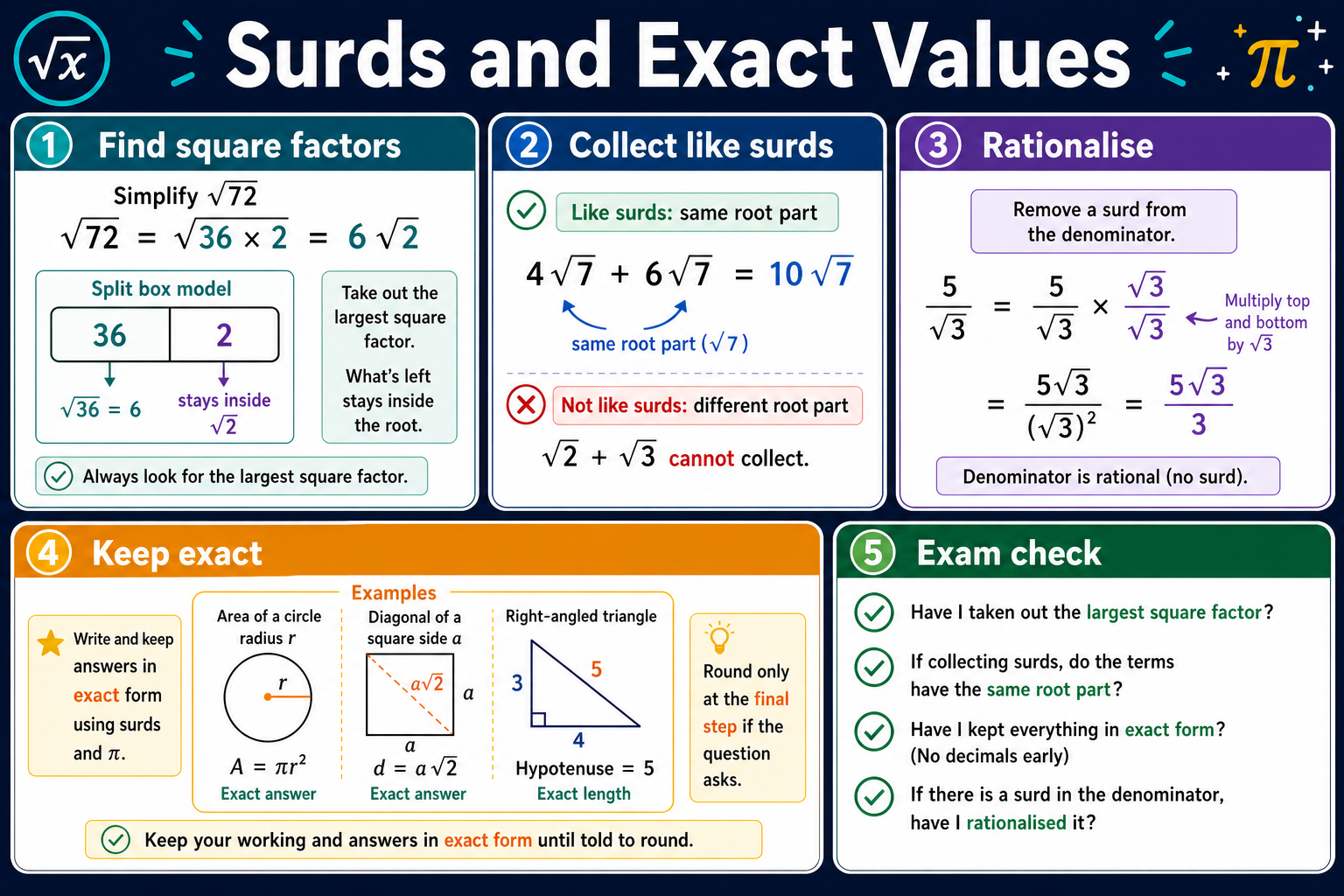
Surds and exact values infographic
Before viewing
Before viewing, find a square factor inside one root and predict how it can simplify.
After viewing
After viewing, simplify one surd and explain why the exact form is better than a rounded decimal.
What you will learn
Key facts before you start
Why this matters
extension problems often expect exact answers such as 3√2 or fractions involving π instead of rounded decimals.
Prior knowledge
You should already be comfortable with:
Clear explanation
Main idea
A surd is an exact irrational root, such as √2 or √5. It cannot be written exactly as a terminating or recurring decimal.
Method
To simplify a surd, split out the largest square factor: √72 = √36 × √2 = 6√2. After simplifying, collect only terms with the same surd part.
Answer tip
Only like surds combine: 3√5 + 2√5 = 5√5, but √3 + √5 does not simplify. When rationalising a denominator, multiply the numerator and denominator by the same surd so the fraction keeps its value.
Worked examples
Simplify a surd
Simplify √98.
Reveal answer
Answer: √98 = √49 × √2 = 7√2.
Rationalise
Simplify 5/√3.
Reveal answer
Answer: Multiply top and bottom by √3 to get 5√3/3.
Collect after simplifying
Simplify √80 − √45.
Reveal answer
Answer: √80 = 4√5 and √45 = 3√5, so √80 − √45 = √5.
Quick checks
Choose an answer, then check your thinking.
1. Which is the simplified form of √72?
2. Which pair can be collected directly?
Practice questions
Question 1
Simplify √50 by splitting out the largest square factor and leave the answer in exact surd form.
Reveal answer and marking guidance
Answer: 5√2.
Marking: √50 = √25 × √2 = 5√2. Credit the largest-square-factor split and the exact final form.
Question 2
Simplify 4√3 + 7√3, explaining why the two terms can be collected.
Reveal answer and marking guidance
Answer: 11√3.
Marking: Both terms are like surds because the root part is √3, so add the coefficients: 4 + 7 = 11.
Question 3
Simplify √12 fully. Do not give a rounded decimal answer.
Reveal answer and marking guidance
Answer: 2√3.
Marking: √12 = √4 × √3 = 2√3. A decimal approximation is not exact.
Question 4
Rationalise 2/√5, giving the final fraction with no surd in the denominator.
Reveal answer and marking guidance
Answer: 2√5/5.
Marking: Multiply numerator and denominator by √5: 2/√5 × √5/√5 = 2√5/5.
Question 5
Simplify √75 and state the square factor you used.
Reveal answer and marking guidance
Answer: 5√3.
Marking: Use the square factor 25: √75 = √25 × √3 = 5√3.
Question 6
Simplify 3√2 + √18 by simplifying √18 first.
Reveal answer and marking guidance
Answer: 6√2.
Marking: √18 = √9 × √2 = 3√2, so 3√2 + 3√2 = 6√2.
Question 7
Expand and simplify √3(√12 + 5), keeping the answer exact.
Reveal answer and marking guidance
Answer: 6 + 5√3.
Marking: √3 × √12 = √36 = 6, and √3 × 5 = 5√3.
Question 8
Rationalise 7/(2√3) and simplify the denominator.
Reveal answer and marking guidance
Answer: 7√3/6.
Marking: Multiply top and bottom by √3: 7√3/(2 × 3) = 7√3/6.
Question 9
Simplify 2√45 − √20, collecting like surds after each root has been simplified.
Reveal answer and marking guidance
Answer: 4√5.
Marking: √45 = 3√5, so 2√45 = 6√5. Also √20 = 2√5, giving 6√5 − 2√5 = 4√5.
Question 10
A square has area 72 cm². Write its side length in simplified surd form.
Reveal answer and marking guidance
Answer: 6√2 cm.
Marking: The side length is √72 cm. Split the largest square factor: √72 = √36 × √2 = 6√2.
Answers and marking guidance
The exact practice answers are hidden under each question so you can try first. For surd questions, marks usually come from splitting out square factors, simplifying fully, collecting only like surds after simplification, rationalising denominators with a matching root, expanding carefully and keeping exact notation until the final requested form.
Common mistakes
- Using a small square factor and stopping: √72 = 6√2 is fully simplified; 3√8 is not.
- Collecting unlike surds: √2 + √3 cannot be combined into √5.
- Rounding too early: exact surd form is often required, especially in extension practice geometry and algebra.
- Rationalising only the top: multiply numerator and denominator by the same surd so the fraction value stays equal.
Extension challenge
Create a question that involves simplifying a surd, adding a like surd and rationalising a simple denominator. Give the final answer in exact form and state which step would lose accuracy if you used decimals.
Reveal answer
Example answer: A strong response keeps every root exact, simplifies square factors fully and explains why rounding would only be acceptable if the question asks for an approximation.
Exam-board guidance
Surds and Exact Values appears mainly in extension practice GCSE Maths number and algebra. The shared skill is to keep roots and π exact, simplify the form carefully and round only when the question asks for an approximation.
AQA GCSE Maths
Focus on the shared method, notation and checking habit; wording and context can vary by route.
OCR GCSE Maths
Show clear method steps and use precise notation; question wording may vary by route.
Pearson Edexcel GCSE Maths
Keep working visible and check units or notation; contexts may vary by route.
Eduqas GCSE Maths
Use the same core skill in practical contexts, with clear reasoning and final checks.
WJEC Wales
Connect the method to the context and state what the result means.
CCEA GCSE Maths
Make each method step visible and keep notation, units and final checks clear.
Next lesson
Next, continue with Recurring Decimals and Fractions.